Have you ever dreamed about spending the night in a castle? A castle with turrets, gargoyles, and suits of armor? Maybe you think you’d have to travel to England or France…and that the price would be steep. Well, you can have that experience in a unique hotel that’s only a little over three hours drive from New York!
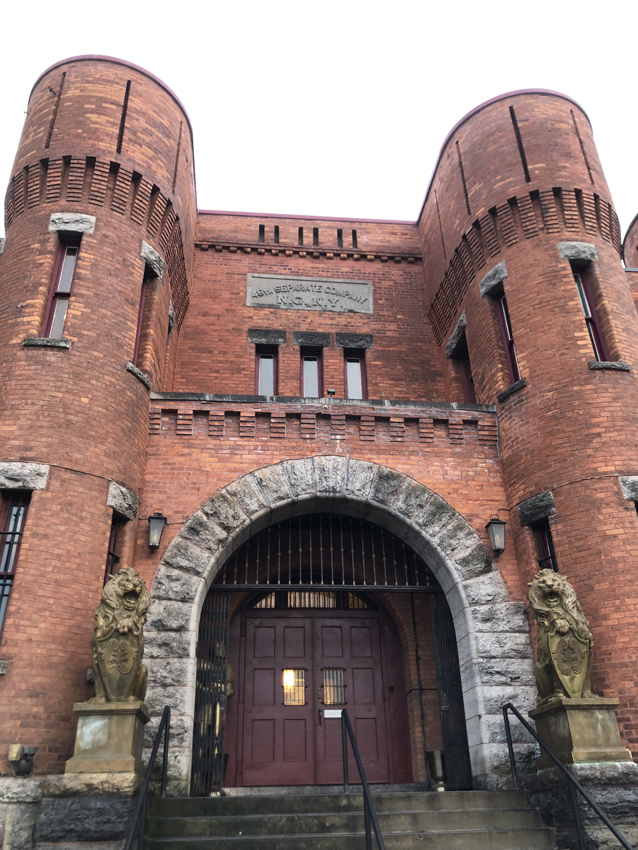
This is Amsterdam Castle, located in the small town of Amsterdam, NY. The building was originally designed by Isaac Perry, one of the architects who worked on the capitol building in Albany. Built in 1895, it originally served as an armory. After it was decommissioned, it passed into private hands and was transformed into a hotel.
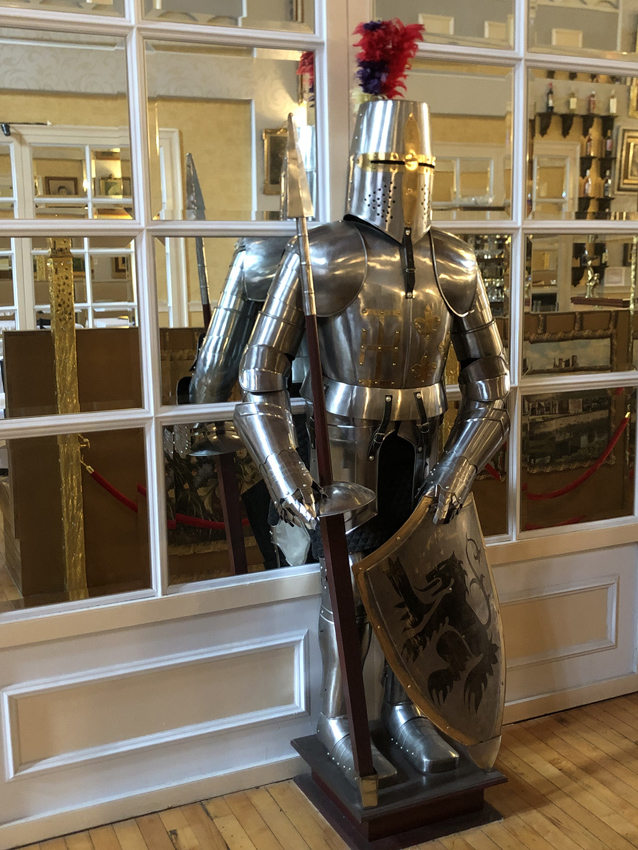
The hotel is decorated in a whimsical, medieval-inspired style. There are suits of armor:
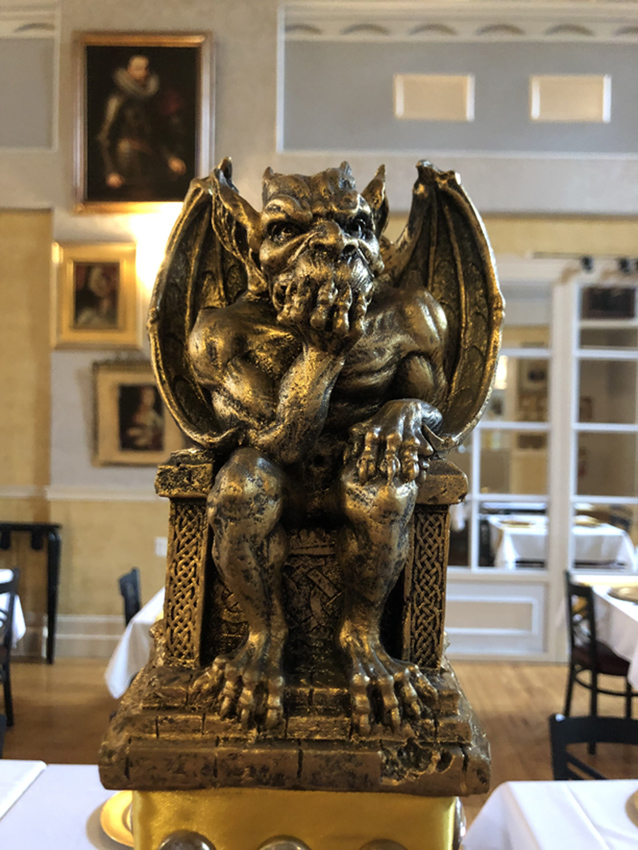
And gargoyles:
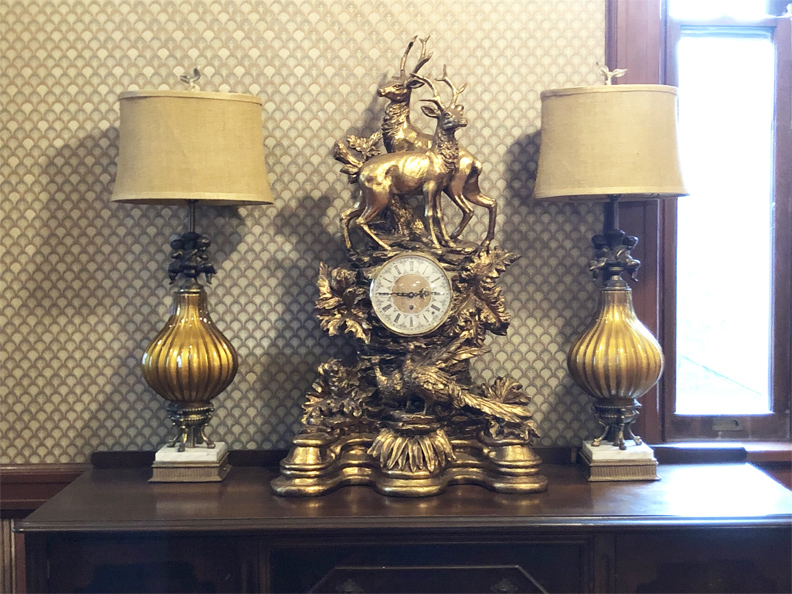
And there are sitting rooms with elegant antique furniture, clocks, and lamps…
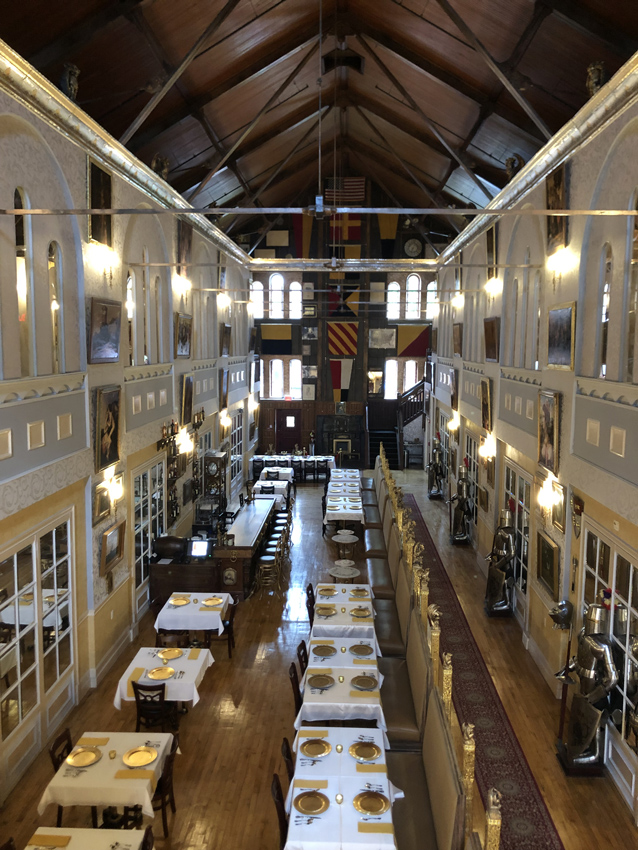
The highlight of the castle is the Great Hall, which is created from the armor’s former drill hall, and has its original high ceiling:
The Great Hall houses a bar, and a restaurant, the latter open on Friday and Saturday evenings.
You can view a short video that I made about the hotel here:
Rooms at this unique hotel start at $122 a night (plus tax). As I mentioned, it’s within driving distance of New York, and is also reachable via Amtrak service.
The hotel is filled with fun nooks and crannies, and has colorful objects everywhere you look! If you love history and fanciful artwork, it’s your castle getaway!
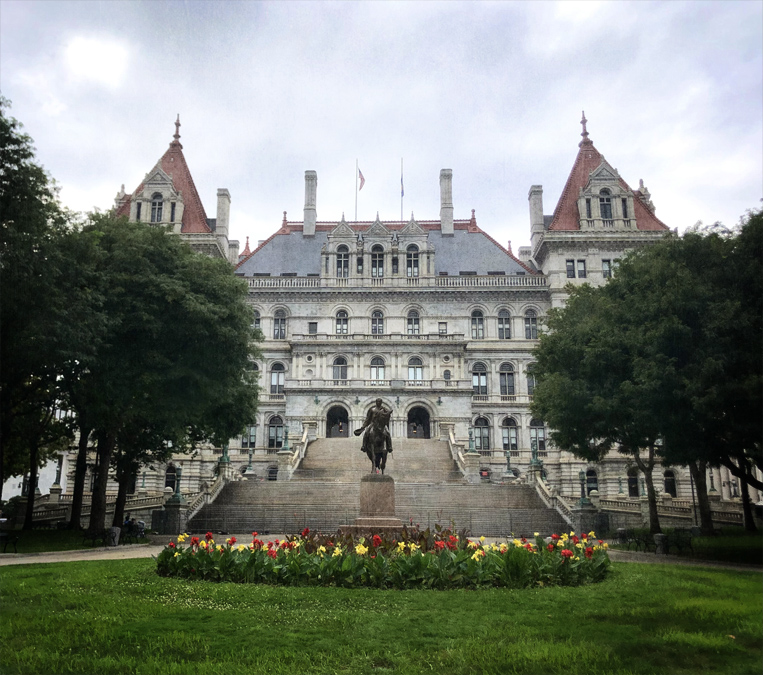
I recently traveled to Albany, NY to visit its capitol building…it’s one of the most flamboyant state capitol buildings. It cost more to construct than the U.S. Capitol! Yet it’s undeniably beautiful, having not one, but THREE monumental staircases…it’s also decorated with an astonishing amount of carved stone, featuring portraits of famous people, animals, and natural motifs.
You can view a video that I made of the Capitol building’s highlights:
Video highlights from the Albany Capitol
Albany is about an hour and a half train ride from New York City. Free guided tours of the capitol building are offered several times a day on weekdays. There are also other attractions in the vicinity, such as the New York State Museum (also free!), which has exhibits about natural history, and the history of New York State!
An estate with fountains, gilded statuary, a colonnade…does this sound like France or Italy? No, it’s the Nemours Estate in Wilmington, Delaware!
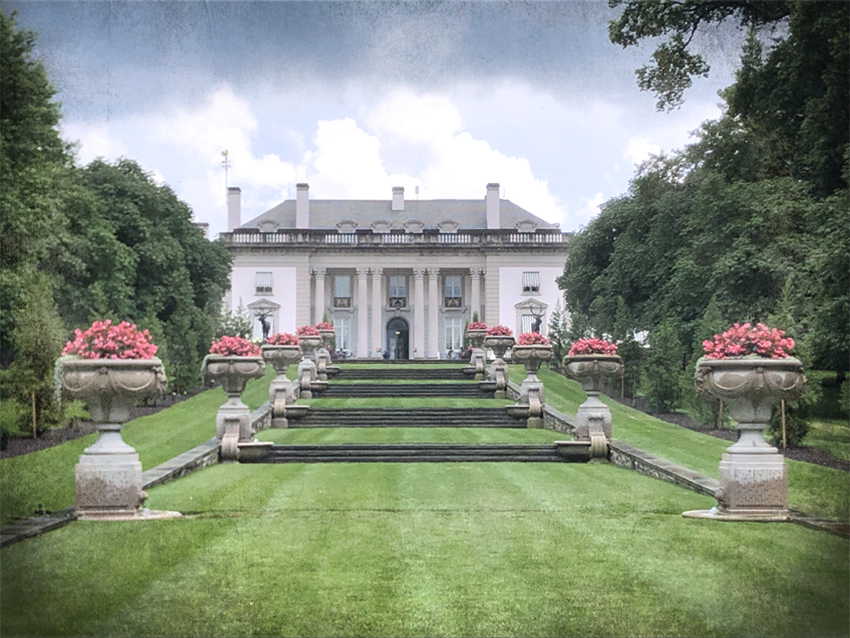
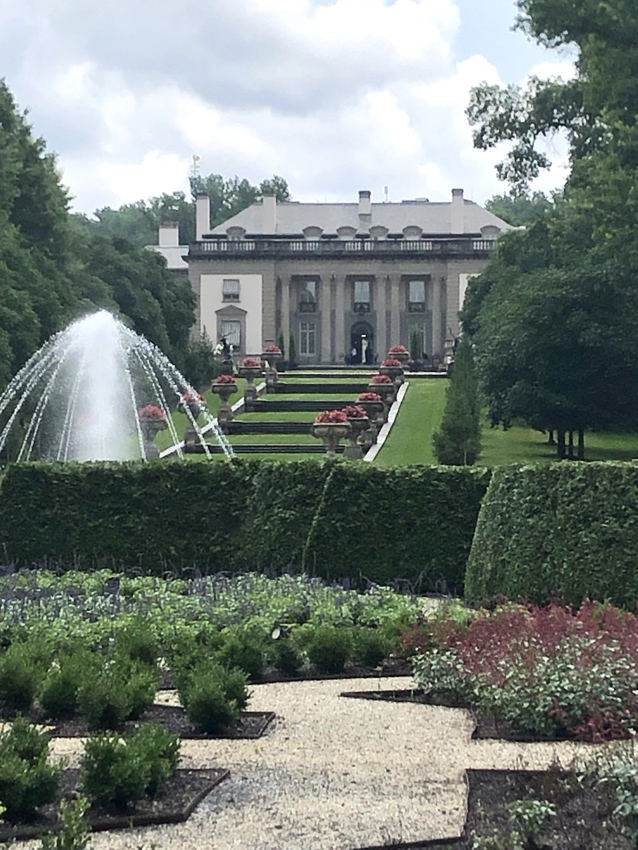
View of the mansion with a terraced walk with ornamental urns
Nemours Estate (1909-10) was built for Alfred I. DuPont. Alfred’s great-great grandfather had fled France in the wake of the French Revolution (narrowly escaping the guillotine!) and come to the United States. The family began to manufacture gunpowder, which created their fortune in the 1800s.
In 1907, after an extremely bitter divorce from his first wife, Alfred married divorcee Alicia Bradford Maddox. Alicia loved Paris and French style. It’s believed that Alfred commissioned the French-style home to win over his new bride. Designed by the famous firm of Carrere and Hastings, the mansion was completed in 1910.
Here is the impressive Reception Room, with its marble floor and coffered ceiling.
The rest of Alfred’s family, already disapproving of his divorce and remarriage, were startled by the extravagance of the house. They and other members of society gossiped about Alicia and her influence on Alfred.
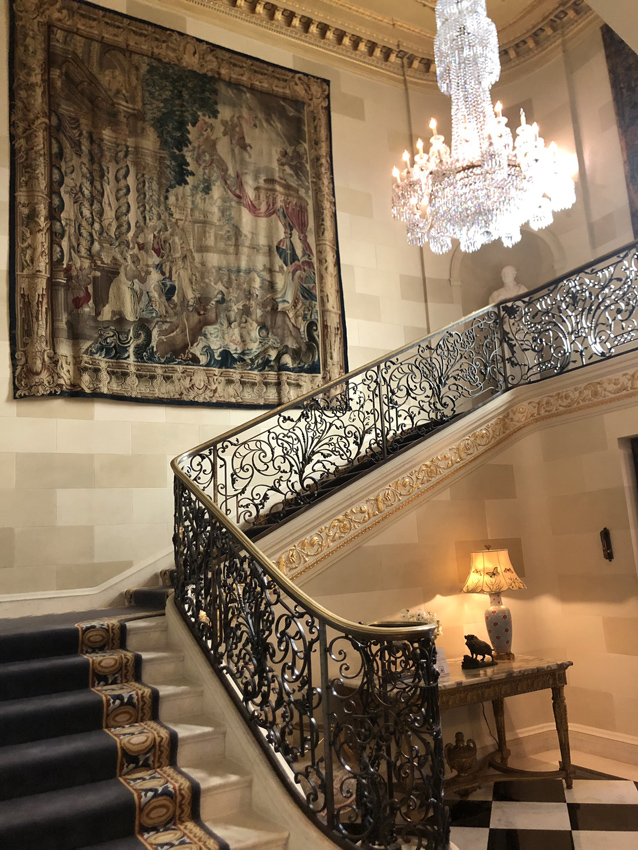
Here you can see the sweeping staircase. The wrought iron decoration was salvaged from a European house.
Unfortunately, for all its magnificence, the house didn’t have its intended effect on Alicia. It appears she never loved Alfred to the extent that he loved her, though he mourned her when she died unexpectedly in 1920.
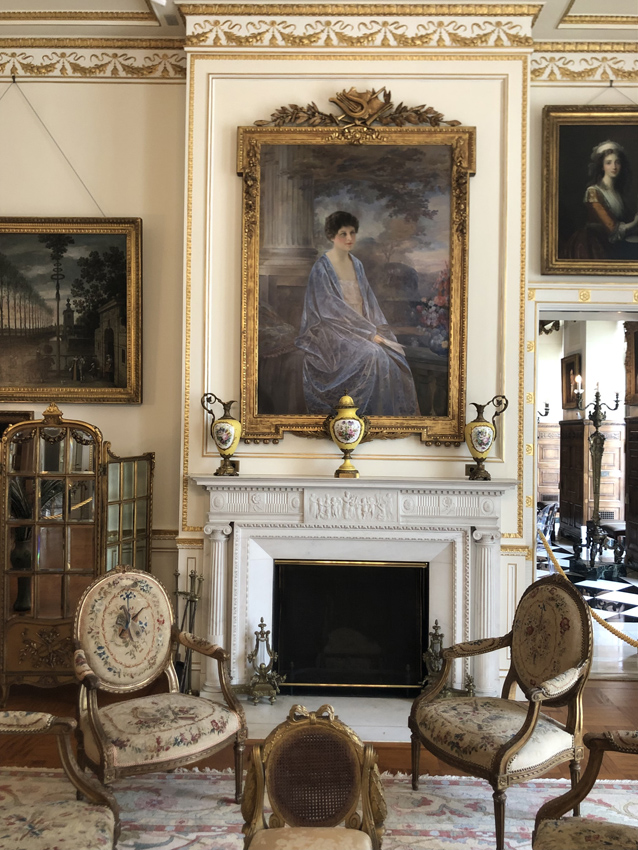
This is the Music Room, in an elegant Neo-Classical style, in gold and white.
In 1921, Alfred married Jessie Ball. She had been working as a schoolteacher, though she came from an old Virginia family. She was considerable younger than him, but this marriage turned out to be a happy one. Jessie’s portrait is hanging over the fireplace in the photo above.
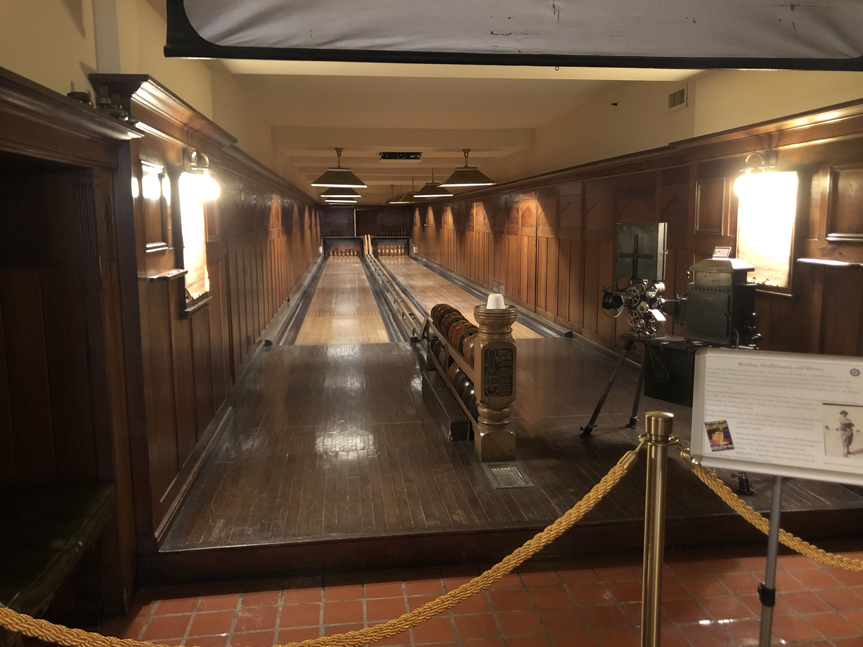
Even though Nemours was built in the style of a 1700s chateau, it boasted every convenience for DuPont and his guests. It included an ice making machine, projector and movie screen, and a private bowling alley!
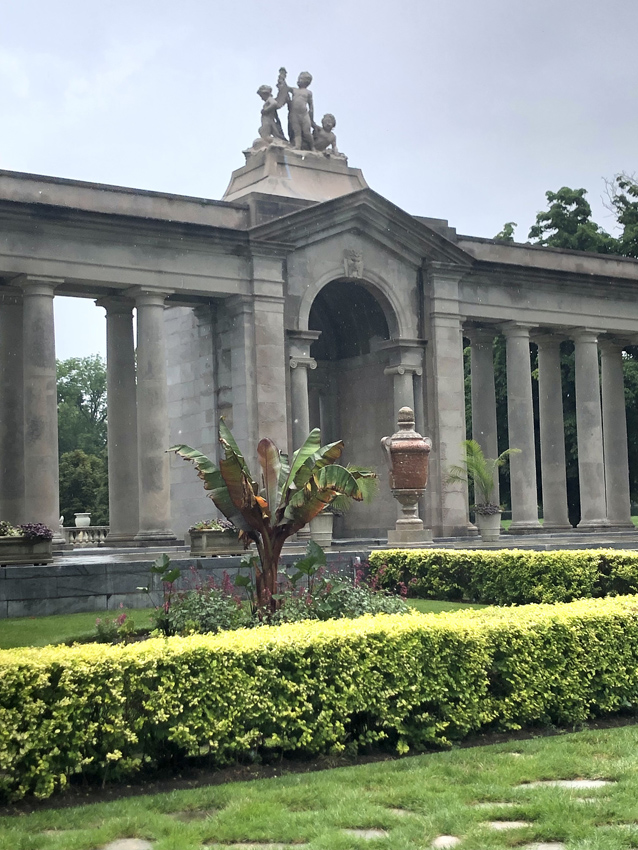
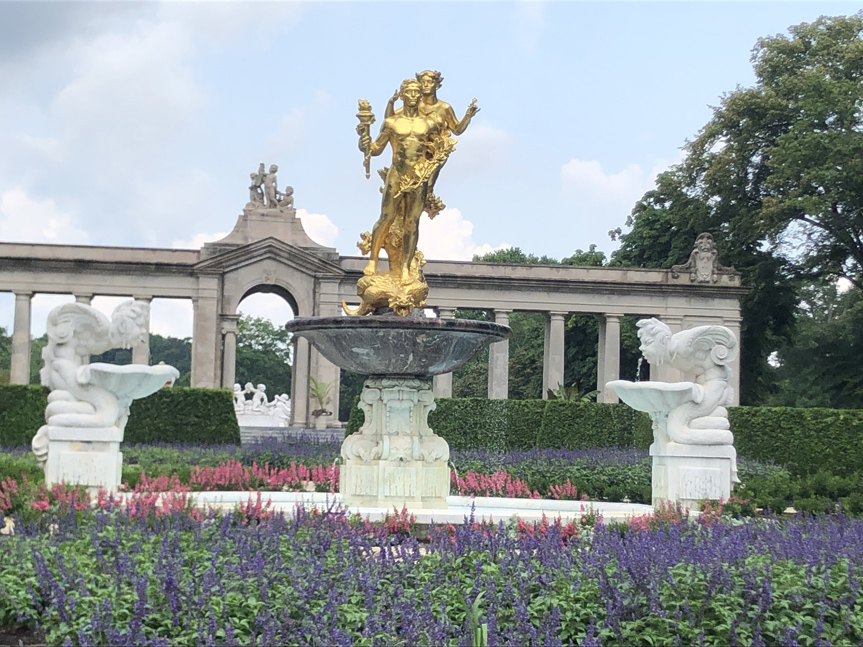
The gardens at Nemours are laid out in a formal French style, with a breathtaking vista that includes fountains, statuary, and a monumental colonnade (seen above). The colonnade includes relief portraits of Alfred’s great-great grandfather and grandfather.
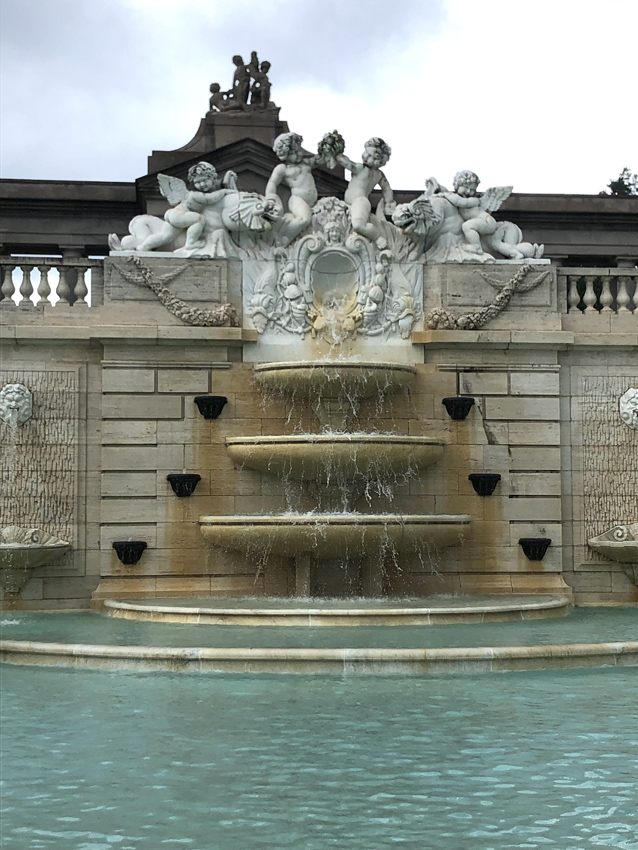
This spectacular fountain, with its ornately carved cherubs, is typical of the style of the gardens. But despite its grand scale, the garden is very harmonious, and extremely pleasant to walk through.
This sculpture, “Achievement,” is covered in real gold leaf! Alfred commissioned it to express “what a man can do with an excellent partner,” a tribute to his wife Jessie. The female figure, said to be modeled upon her likeness, whispers into the ear of the man as he strides forward.
Alfred is buried with Jessie on the grounds of the estate. Just outside the entrance to the property, you can see the Nemours Children’s Hospital…Alfred donated money and land from the estate for the creation of the hospital.
I highly recommend a visit to Nemours! The mansion and gardens are as grand and colorful as Alfred DuPont’s personality, and it’s fascinating to learn about him and his family. The estate is also one of the most beautiful historic homes I’ve visited, with its carefully preserved interiors and lovingly tended gardens. The estate is within driving distance of New Jersey and Pennsylvania…or you can take the Amtrak train to Wilmington. From the train station, you can either take a taxi, or use the DART bus (Route 28), which stops across the road from the mansion at the Children’s Hospital.
To read more about Alfred I. DuPont and Nemours Estate, read Nemours: A Portrait of AlfredI. DuPont’s House by Dwight Young and Grace Gary. It’s filled with historical information and beautiful photographs! (I referred to the book for background when writing this blog post.)
Doylestown, PA is home to an unexpected monument…a castle!
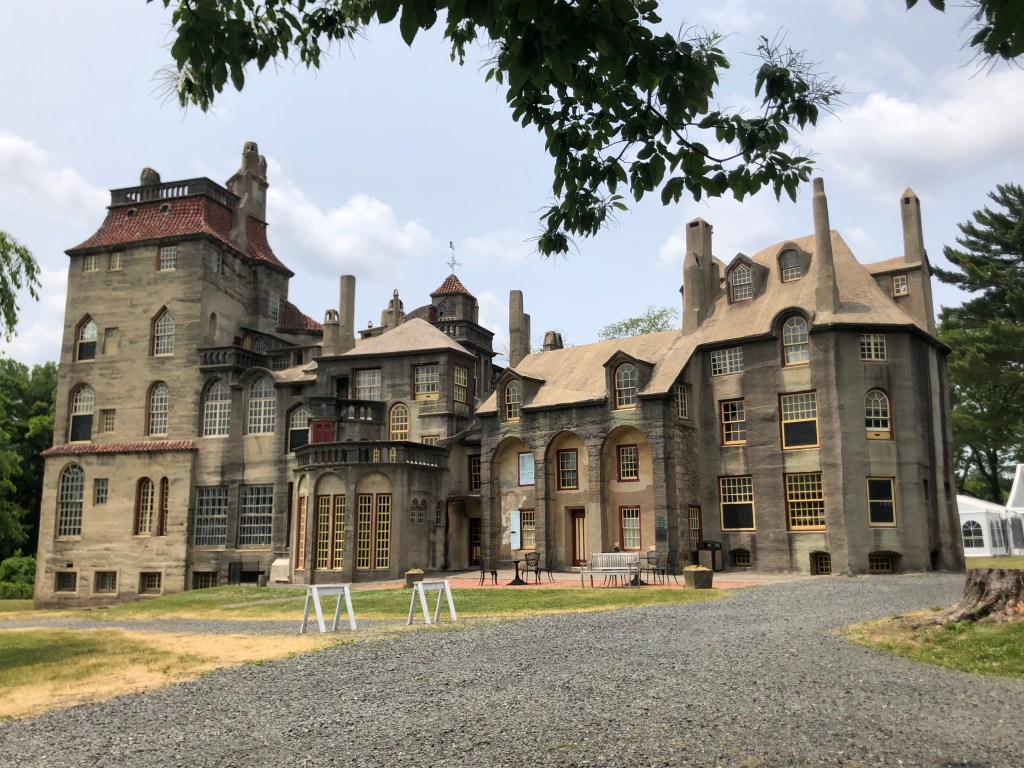
With its fanciful silhouette, chimneys, and towers, Fonthill looks like it could be a school for wizards in training…but it’s actually the brainchild of Henry Chapman Mercer.
Mercer was the son of a prominent local family. He was deeply interested in early trades and crafts, and apprenticed himself to a Pennsylvania German potter. He designed and collected ceramic tiles, founding the Moravian Pottery and Tile Works in 1898 (located just next door).
in 1908, Mercer started building Fonthill, which was intended to be both his home and a showcase for his vast collection of tiles. He was not trained as an architect, but drew inspiration from his extensive travels to sites around the world.
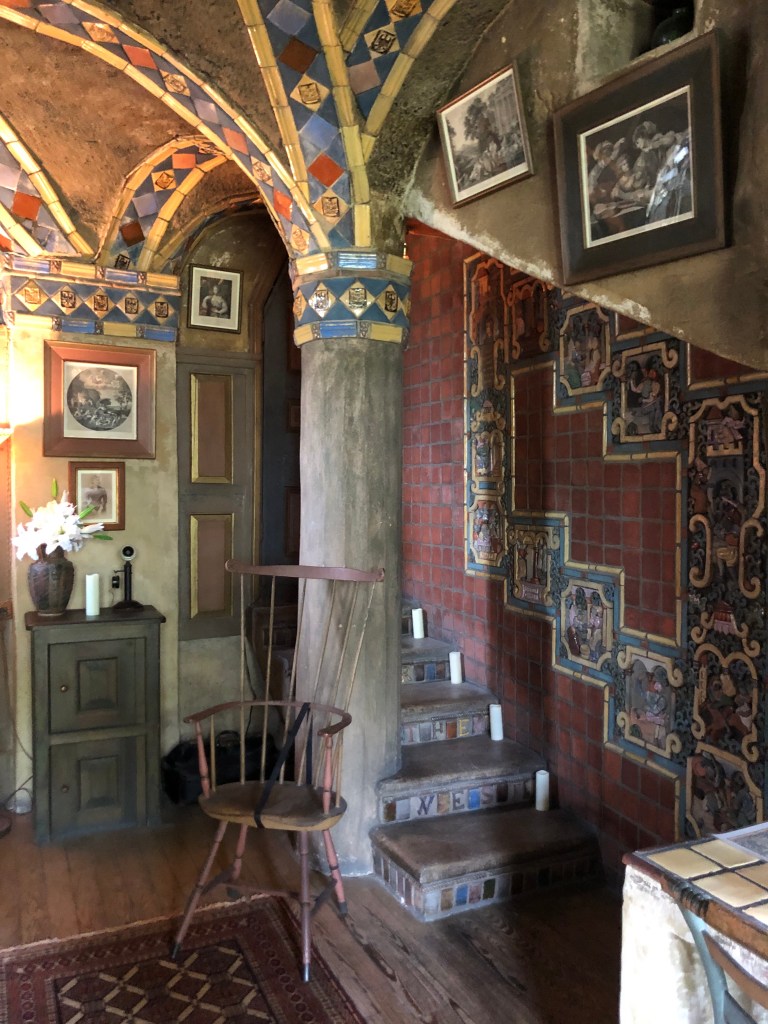
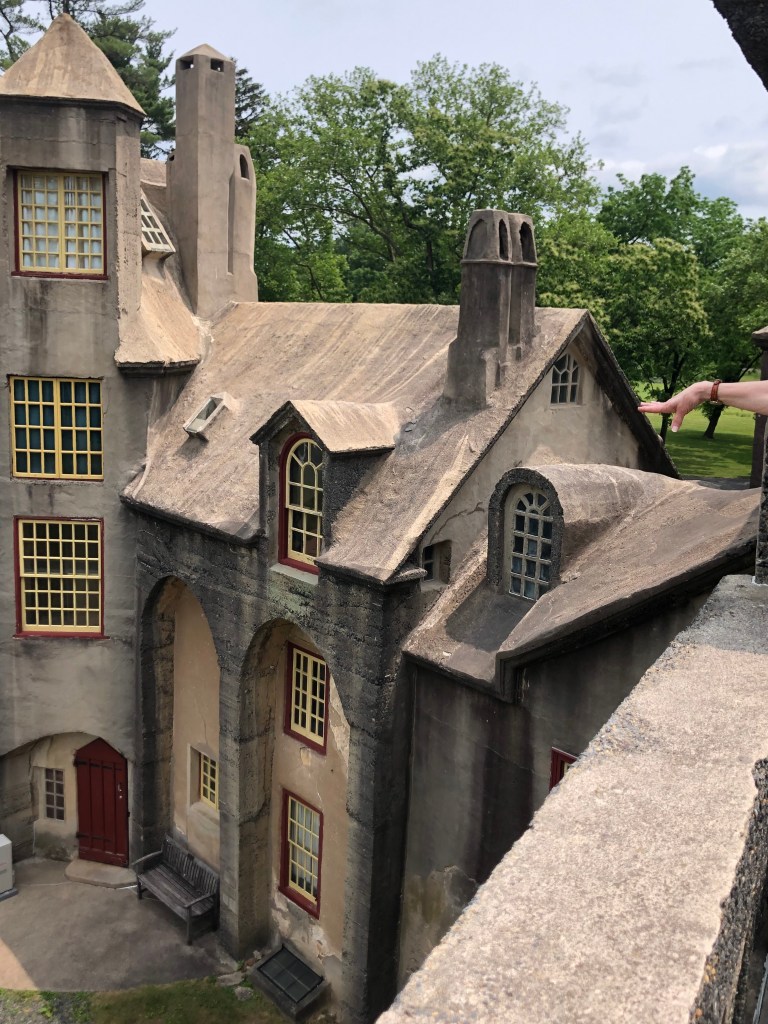
The interior recalls styles of the past, with pillars and vaulted ceilings. The layout seems to follow its own logic, a maze of rooms connected by corridors, winding stairs, and secret nooks around every corner.
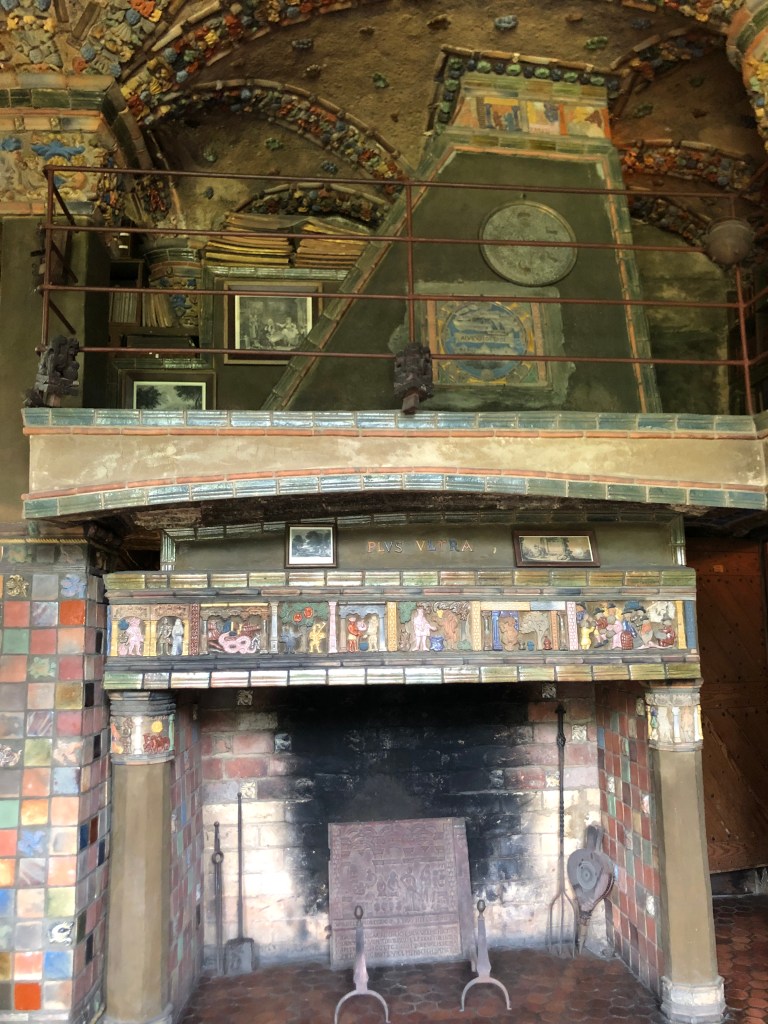
And…tiles. Many of the tiles are Mercer’s own design, brightly colored scenes, often with narratives. The narratives are sometimes scenes of everyday life, others drawn from history. The tiles are EVERYWHERE… set into walls, fireplaces, and ceilings. Even the bathrooms are decorated with tiles!
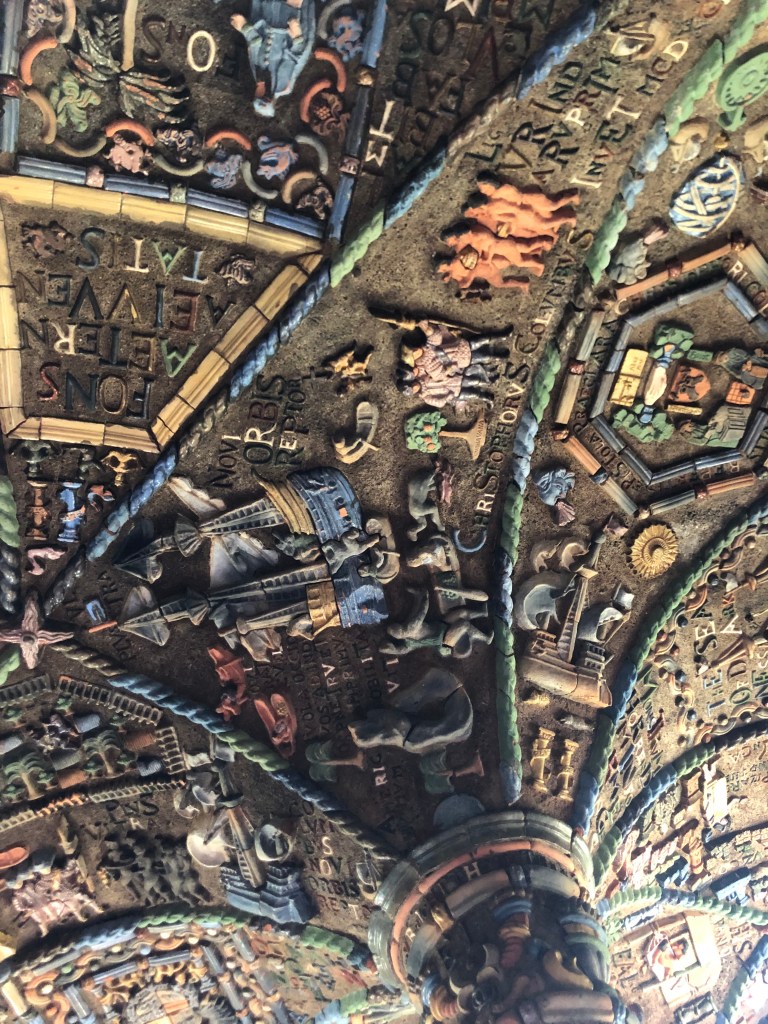
The room above is dedicated to the theme of Christopher Columbus’ voyage to the New World. The vaulted ceiling is covered with tiles and ceramic figures portraying the ships, the sailors, and the Native Americans that they encountered.
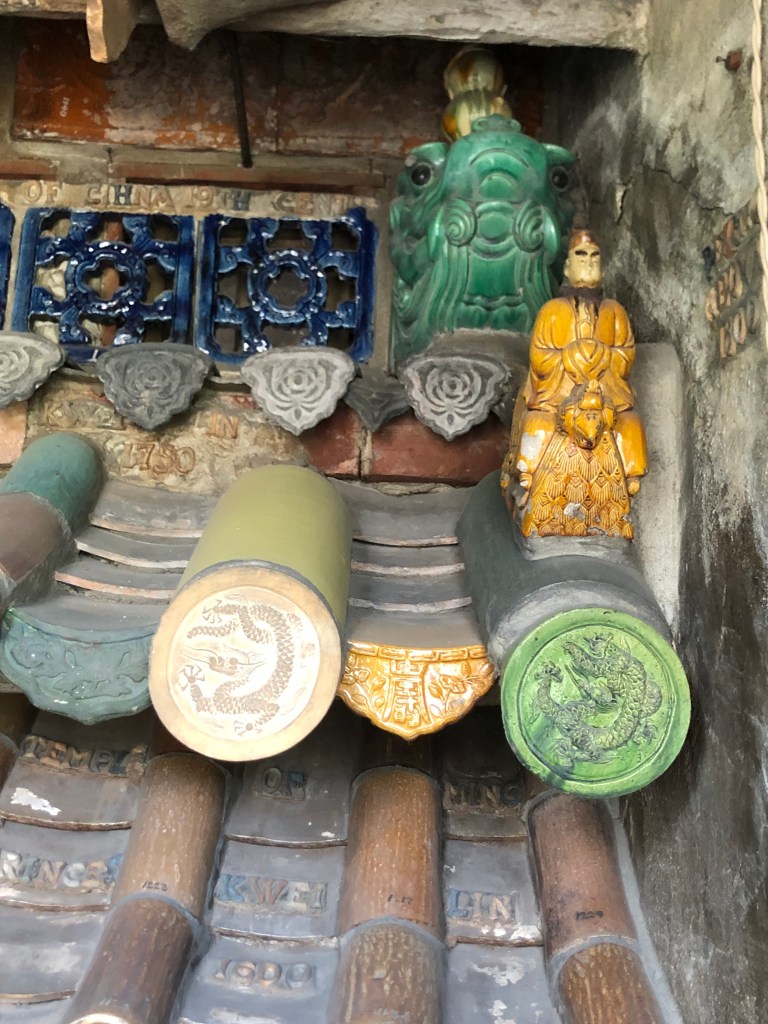
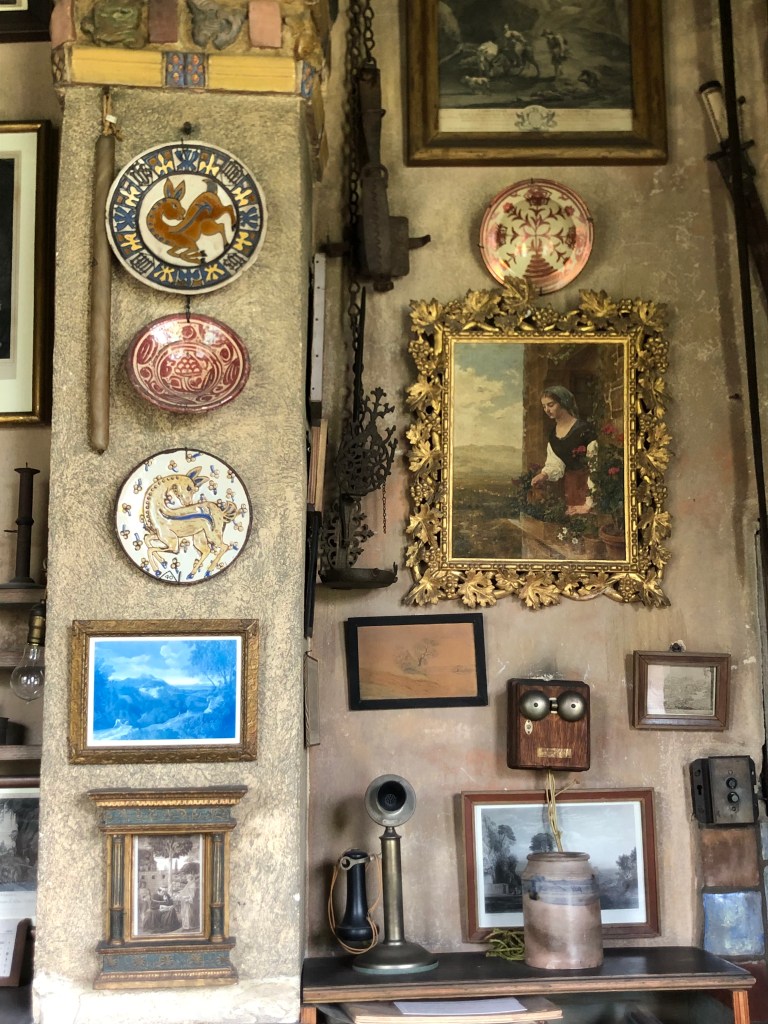
Mercer’s home also displays his collection of historic tiles, including Dutch, Spanish, Chinese and Persian tiles.
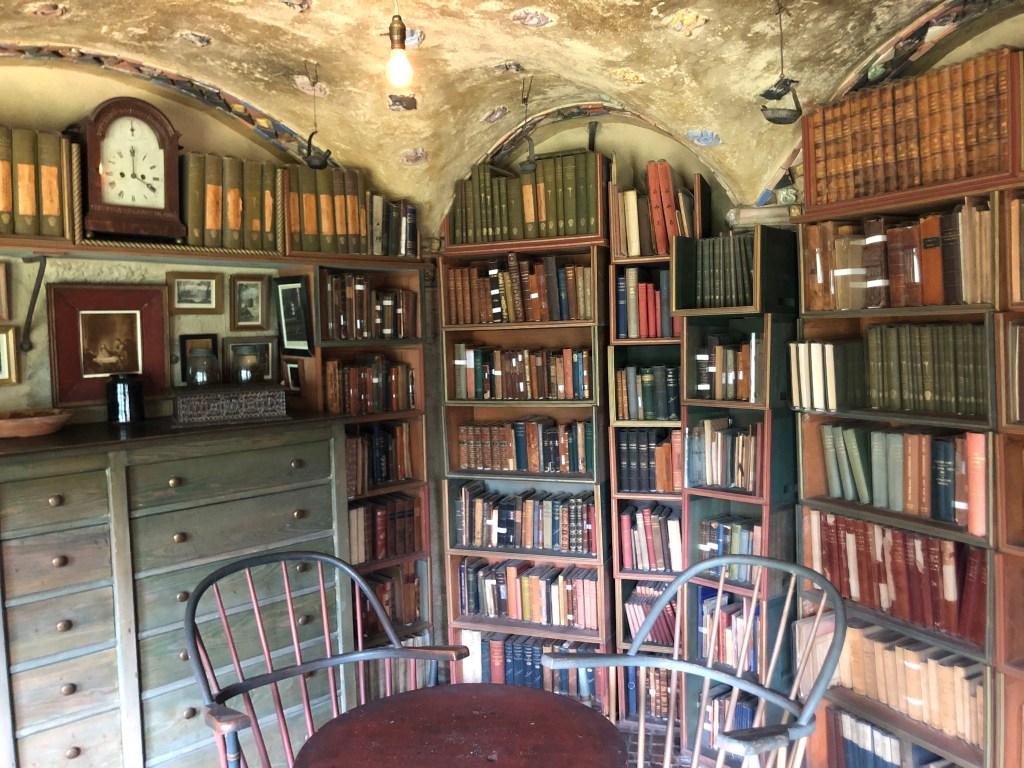
Mercer owned almost 6,000 books, many of which you can see displayed around the home.
You can also see the many paintings, prints, and other artifacts that Mercer collected during his lifetime.
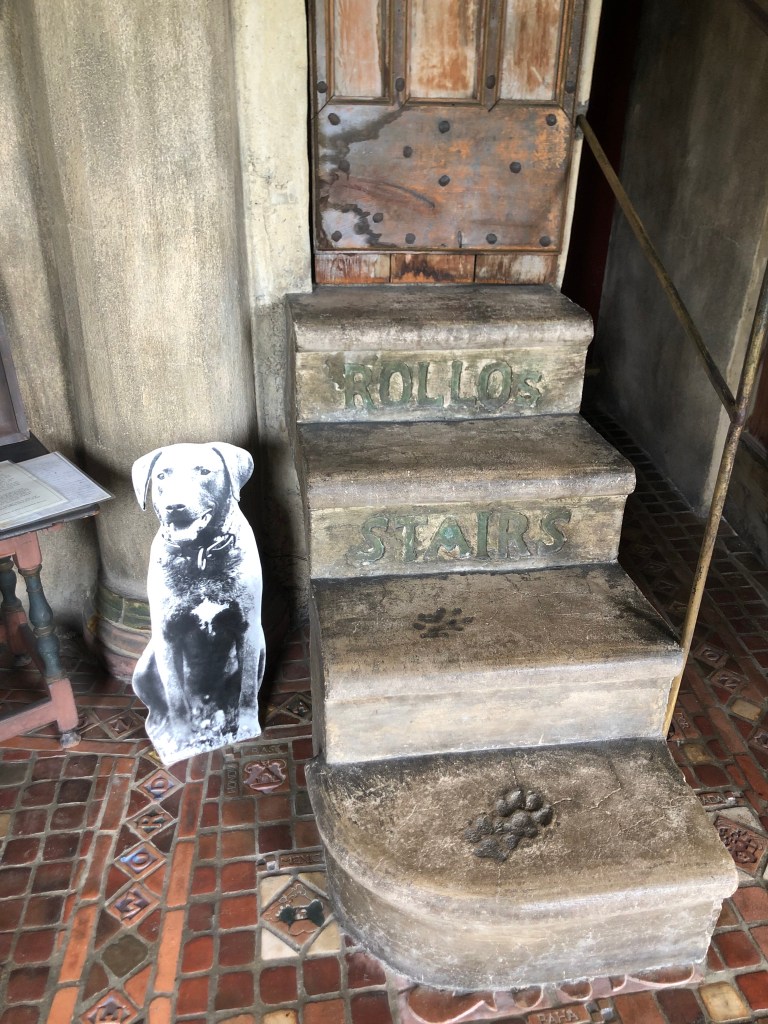
Walking around the house, you really get a sense of Mercer’s offbeat personality. This staircase immortalizes his dog, Rollo, whose pawprints are preserved in the concrete.
While the “castle” draws on the traditions of the past, it’s also quite modern for its time. It’s constructed from poured concrete. It was also equipped with the latest conveniences, featuring numerous bathrooms, an elevator, an intercom and telephones!
Mercer died in 1930, leaving his home to be a museum of tiles and prints. A visit to Fonthill gives us a glimpse into his unique personality and creative process. The museum gives regularly scheduled tours of the building…if you have the chance, visit! It’s a fun and eye-opening experience!
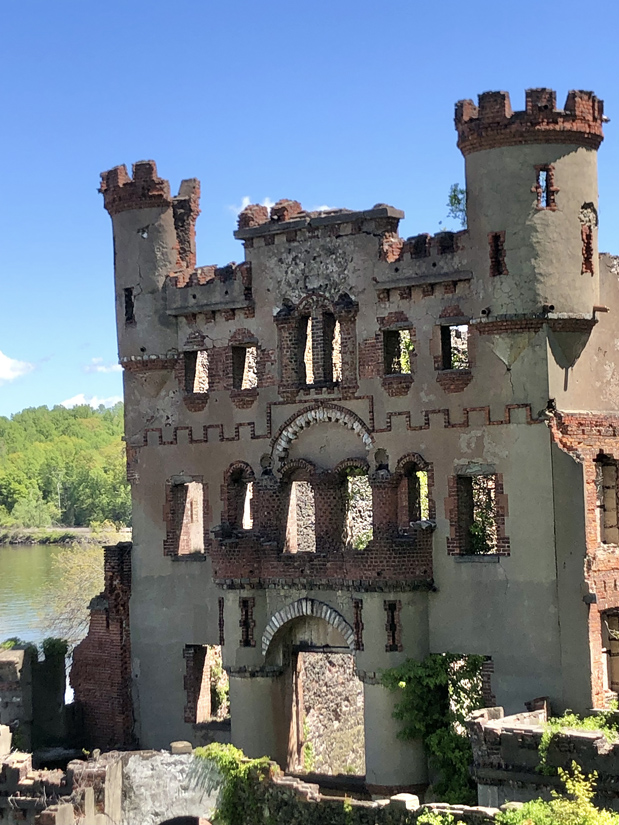
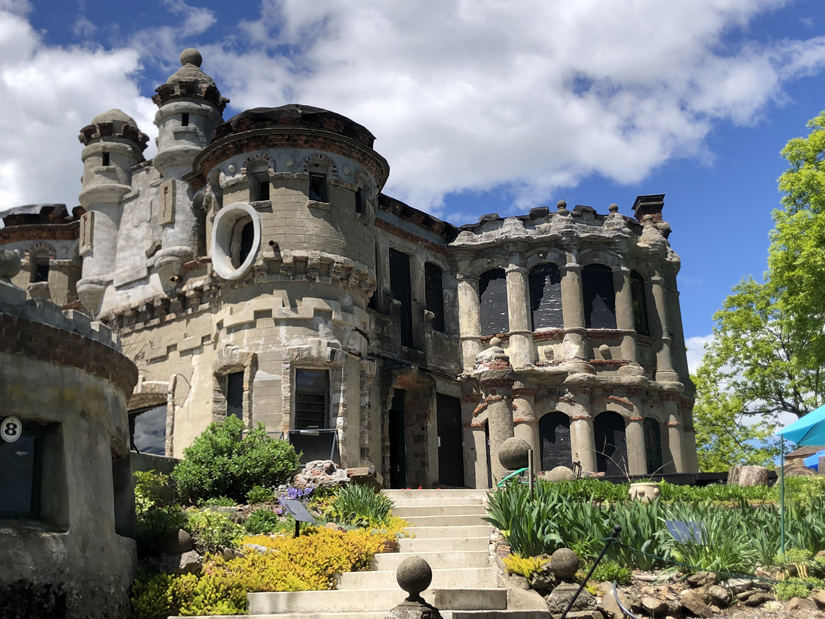
Imagine seeing the ruins of a castle, perched on a rocky island in the middle of a river…it may sound like something from the pages of a gothic novel. But this castle is real…and it’s located only 50 miles from New York City!
Bannerman Castle is on Pollepel Island, just down the river from Beacon, NY. A brief ferry ride took me and the other visitors to the island.
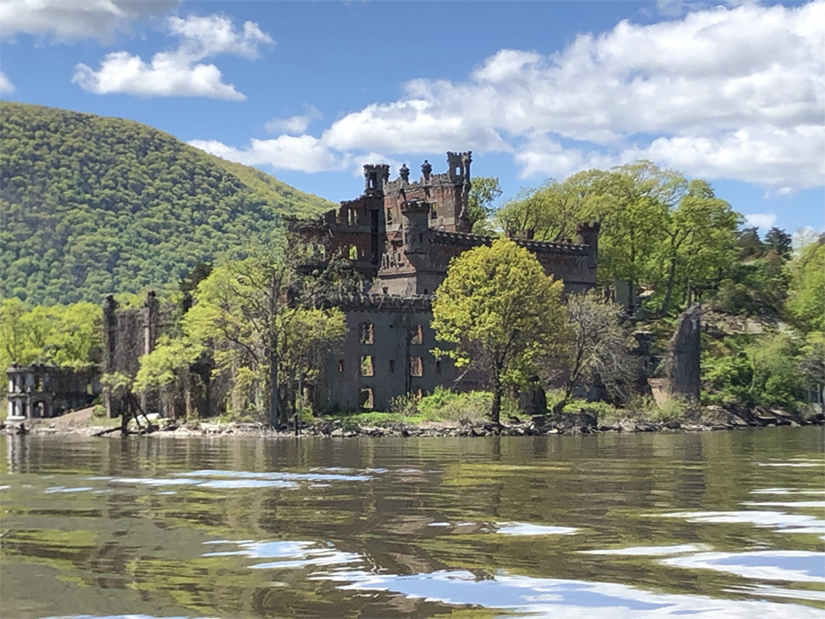
After climbing a 72-step staircase (!), we were rewarded with this view of the castle:
The castle was the brainchild of businessman Francis Bannerman VI, a dealer in military surplus. In 1901, he started building the structure to hold his inventory of guns, ammunition, and other military equipment.
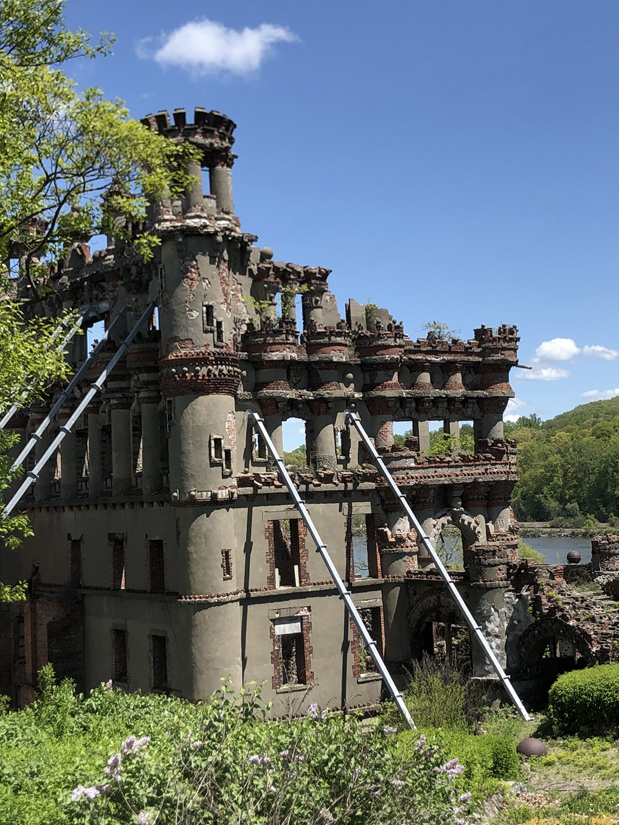
Unfortunately, some of Bannerman’s stored ammunition exploded in 1920 and damaged the building. Later on, in 1969, a fire of unknown origin caused even more severe damage. Steel beams have been added to the walls to support them, and visitors are not allowed to go inside. However, the ruin is still very impressive!
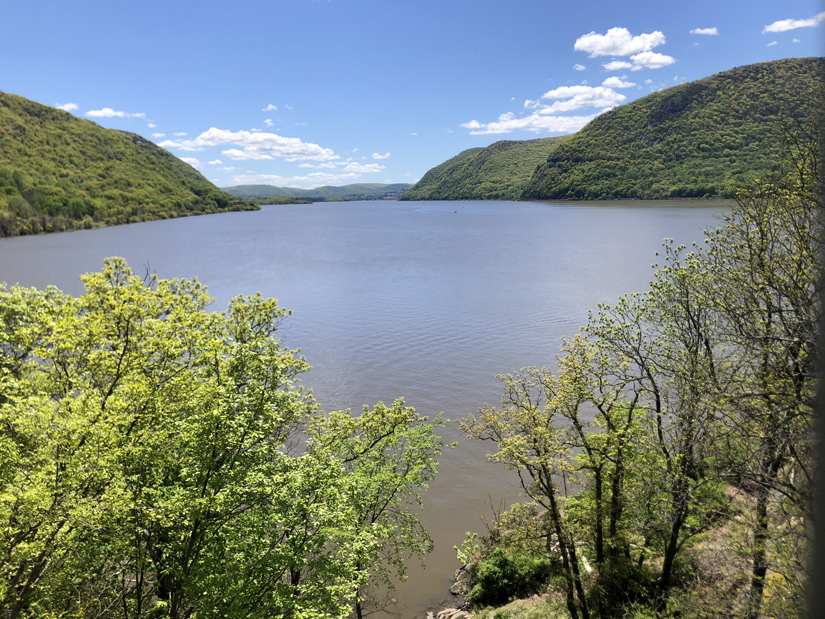
The island itself offers majestic views of the surrounding Hudson Highlands.
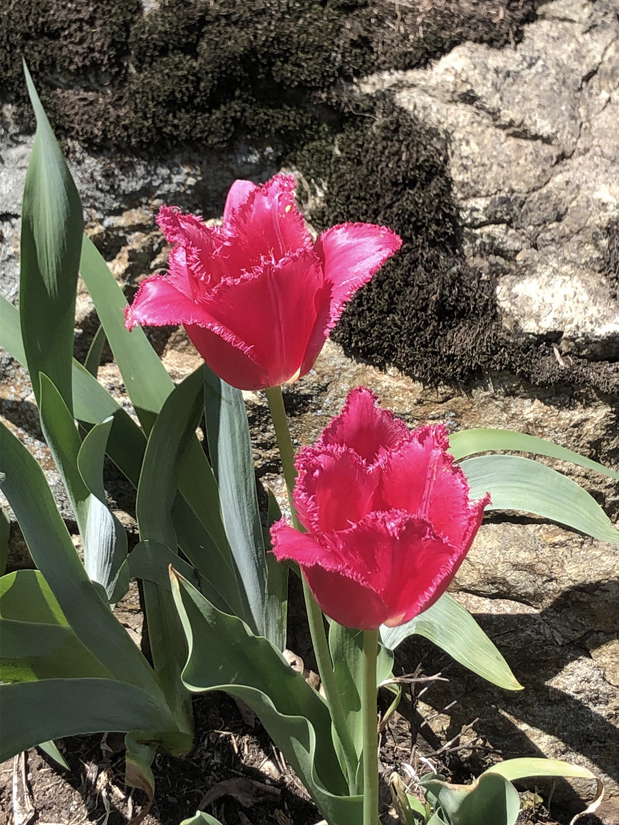
You can also follow several walking trails around the island. Along the way, you can enjoy a variety of flowers, like these vibrant tulips.
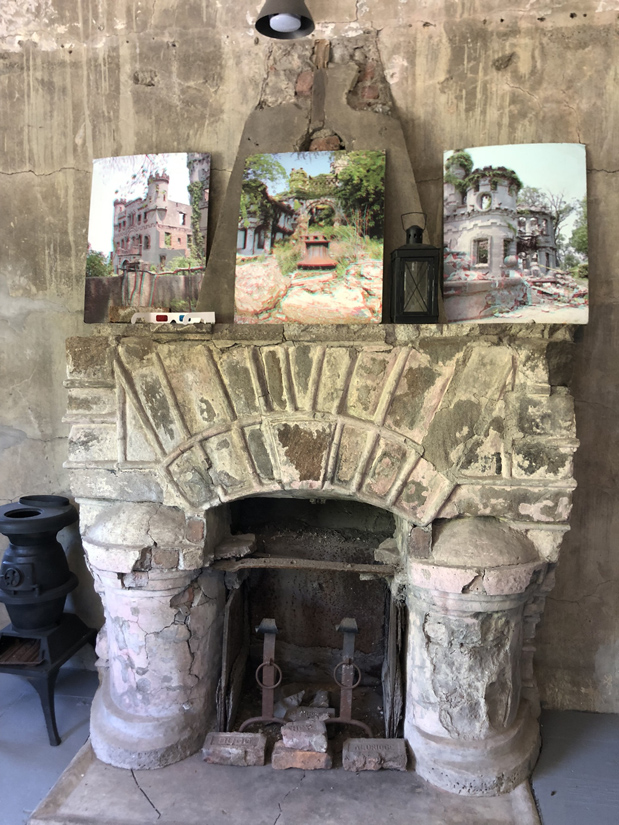
Another point of interest is the Bannerman family’s home, smaller in scale than the castle, but equally fanciful.
Today the building houses displays about the history of the castle and the Bannerman family.
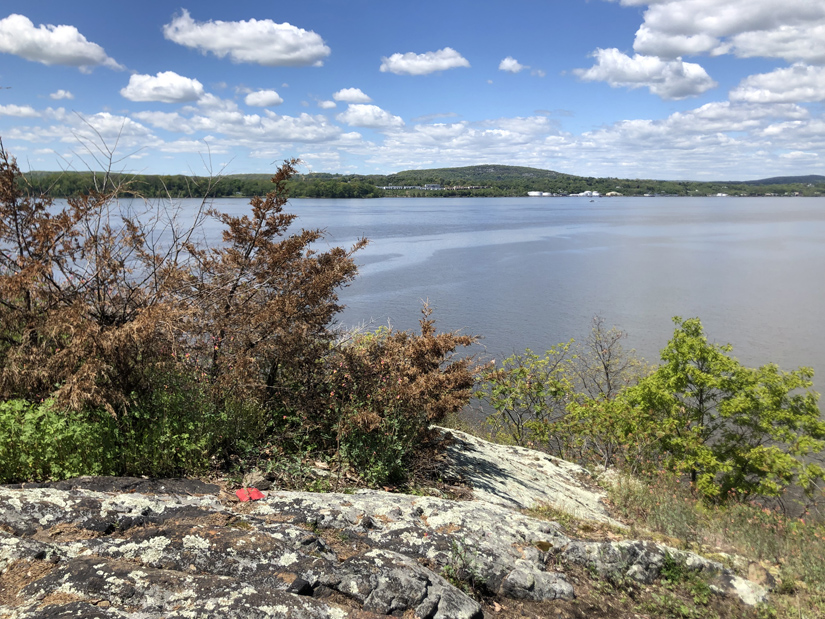
Before leaving, I walked up to one of the highest spots on the island and enjoyed a peaceful view of the river and neighboring Newburgh, NY…the perfect end to an afternoon’s adventure!
The Bannerman Castle Trust offers regularly scheduled guided tours that depart from Beacon. For more details, visit their website: https://bannermancastle.org/
Vanderbilt Mansion: Gilded Age Glamor in Hyde Park, New York
You’re probably familiar with the lavish Gilded Age mansions of Newport, Rhode Island…but did you know that there’s an equally elegant mansion in Hyde Park, NY?
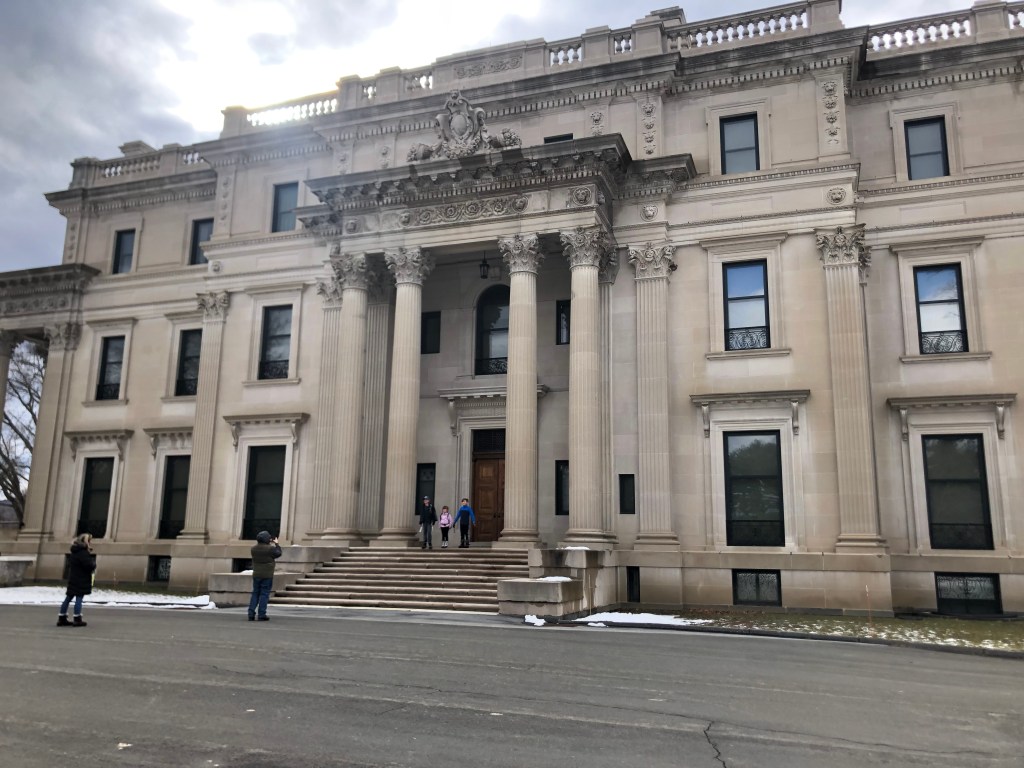
The stately facade of the mansion
It’s the Vanderbilt Mansion, finished in 1899, home of Frederick and Louise Vanderbilt. The home is relatively modest, compared to those of Frederick’s siblings…however, the 50 room dwelling is anything but plain.
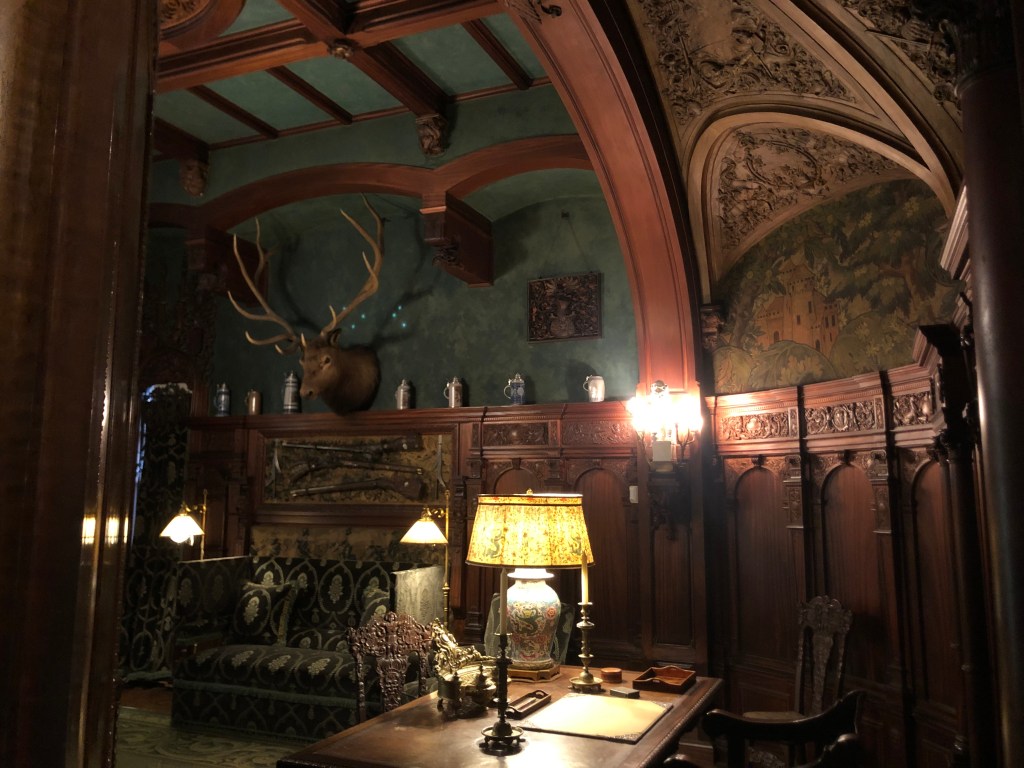
The den, suggesting a medieval hunting lodge, with its dark paneling and firearms
The rooms are richly decorated in a mixture of styles, evoking Renaissance Italy and 18th century France. Elements such as antique tapestries and carved stone fireplaces were imported from Europe.
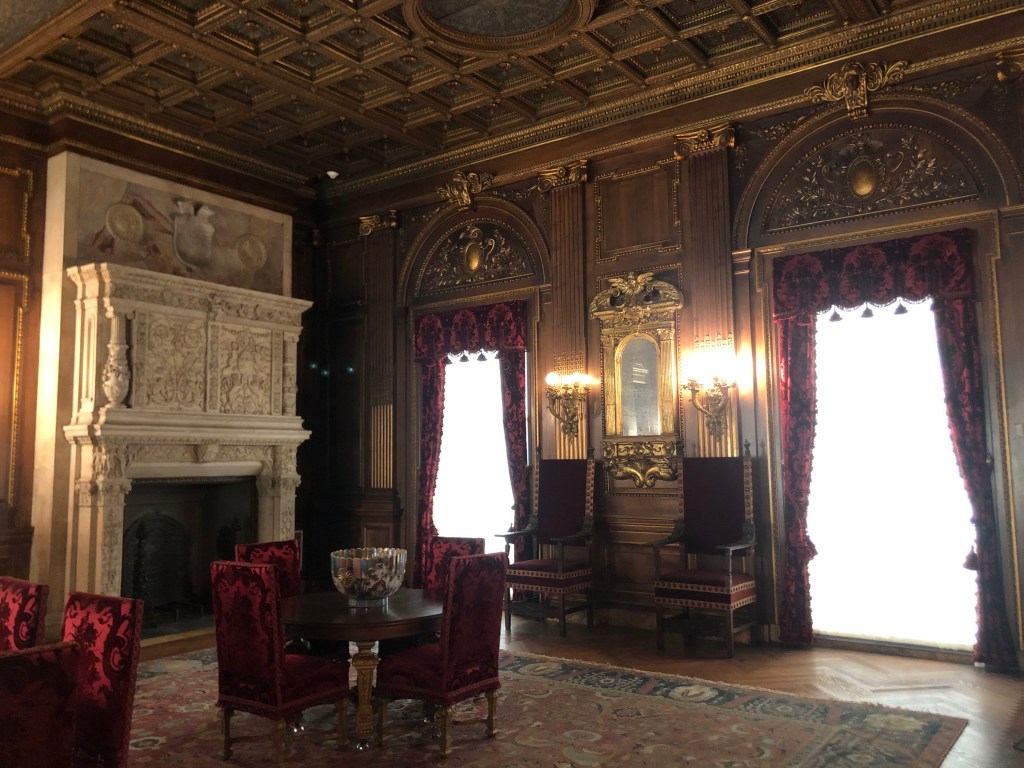
Dining room with coffered ceiling, stone fireplaces, and antique Persian carpet
Louise Vanderbilt was more outgoing than her quiet husband, and enjoyed entertaining guests at the mansion. There was riding, tennis, golf, as well as dinners and dancing.
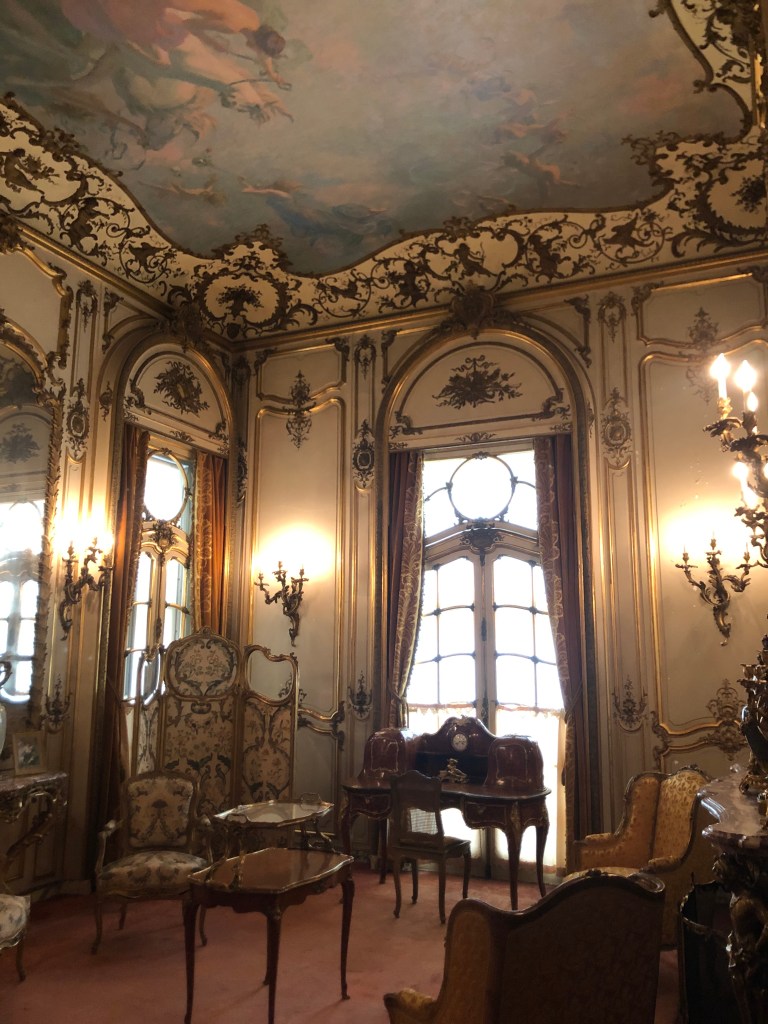
18th century French style reception room
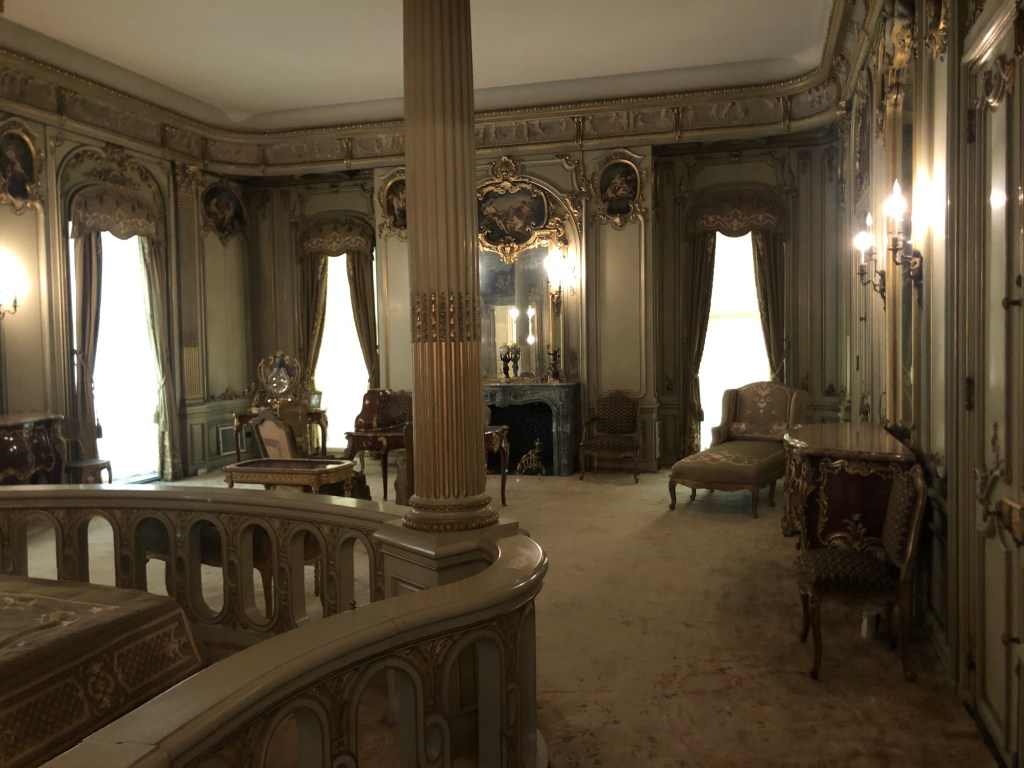
Louise Vanderbilt’s bedroom, complete with a ceremonial railing around the bed, is quite literally fit for royalty.
Louise Vanderbilt’s very feminine,18th century French style bedroom
Yet despite evoking the splendor of historical royalty, the mansion was equipped with modern convenience: electricity, central heating, and indoor plumbing.
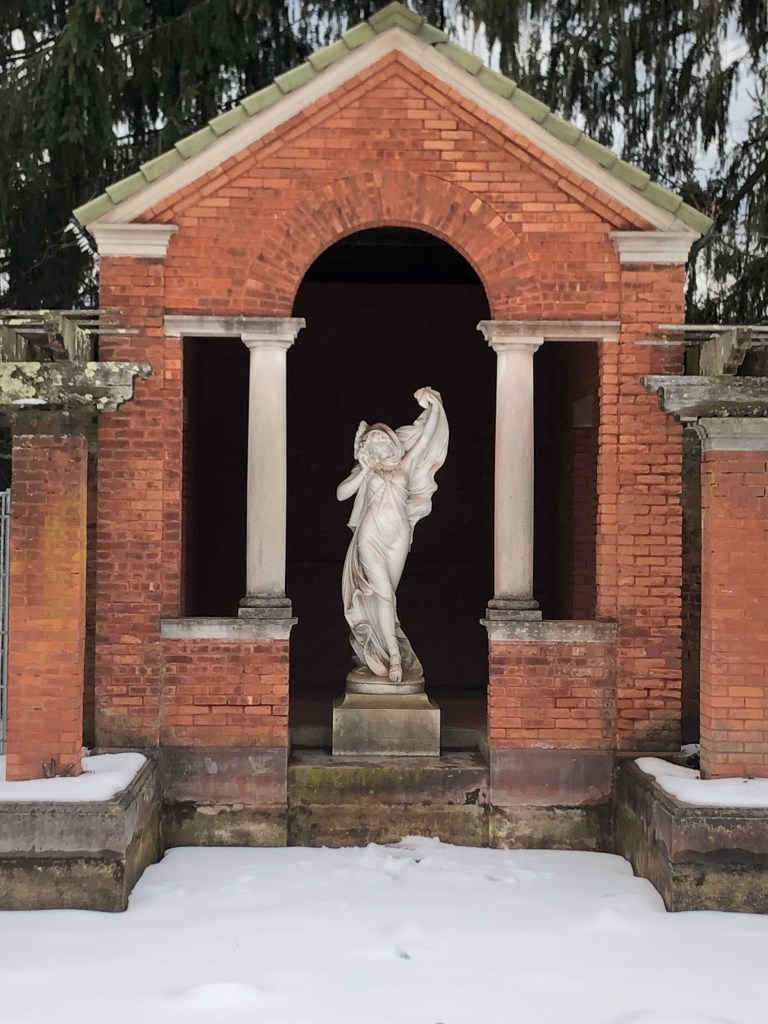
Statue of a veiled dancer, overlooking the reflecting pool
The mansion also retains its formal gardens, with flower beds, pools, and statues. While I visited out of season, you can still admire the terraces and brick pavilions.
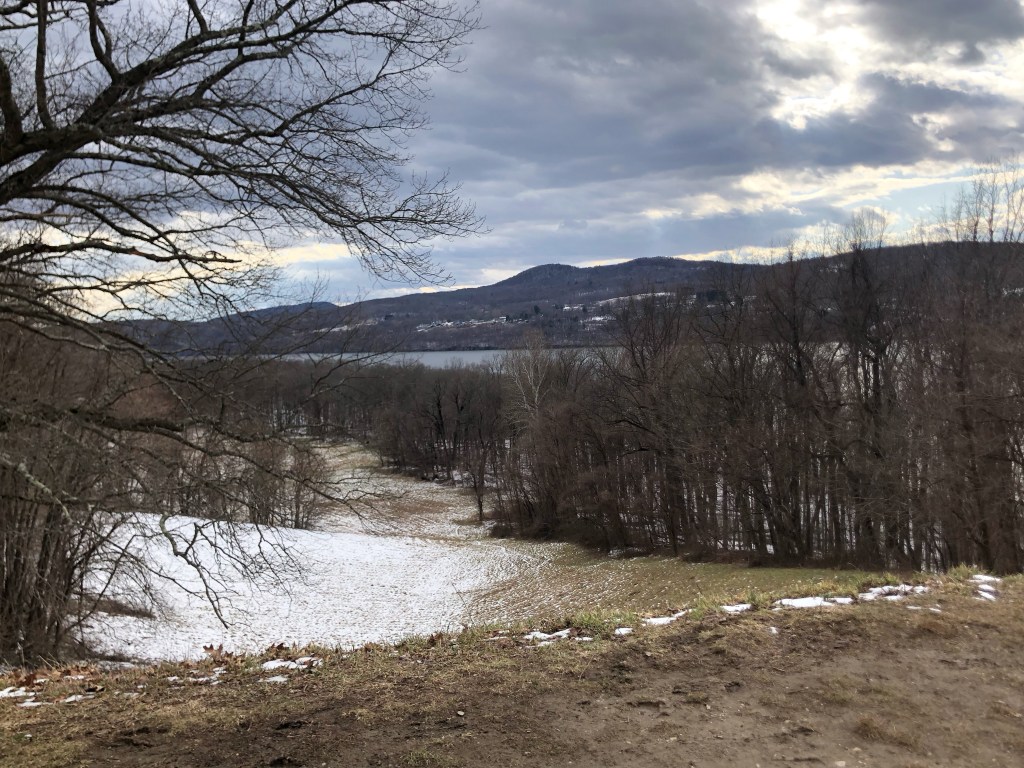
View of the Hudson River
The mansion sits in a wooded, park-like setting, with many walking trails. You can also look out at the Hudson River, and the mountains in the distance.
Louise Vanderbilt passed away in 1926. Frederick Vanderbilt continued to live in the house until his death in 1938. His niece eventually gave the property to the National Park Service, allowing us to visit and enjoy it today.
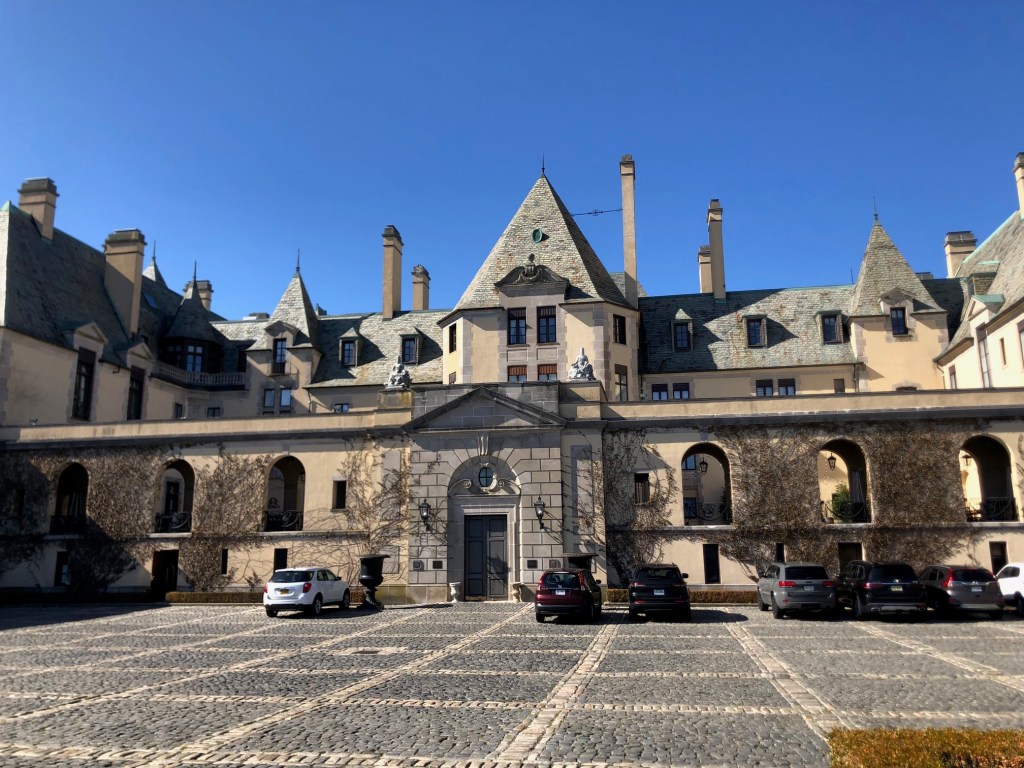
Last month, I got to visit a storybook chateau…but instead of going to France, I traveled to Huntington, NY!
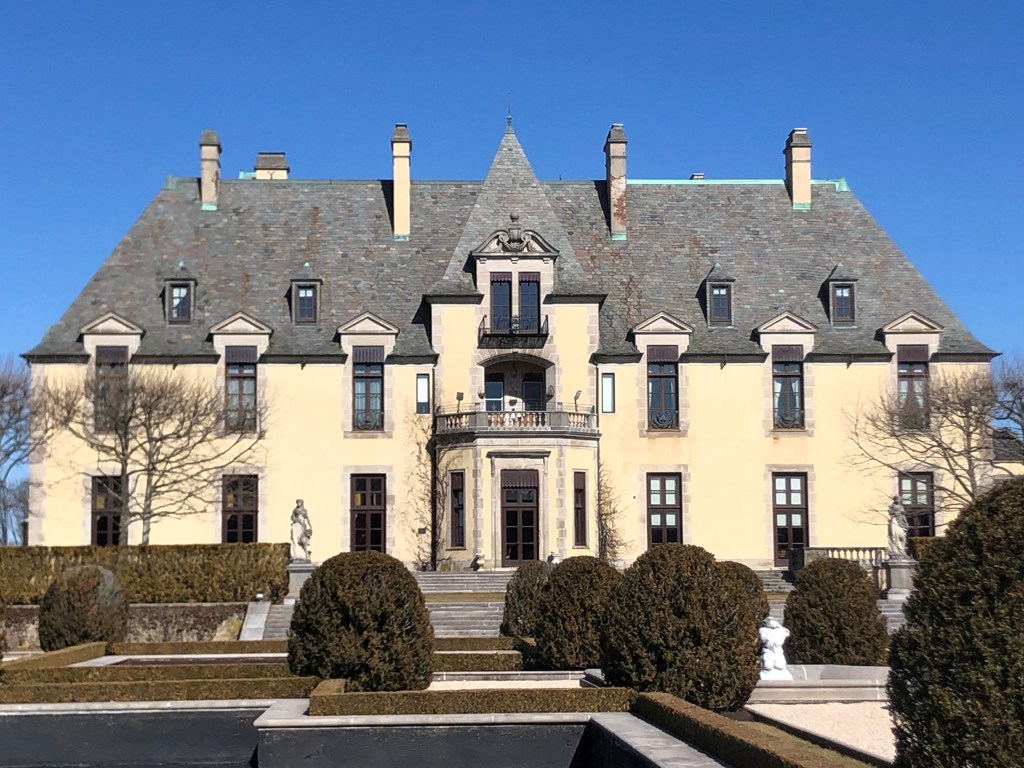
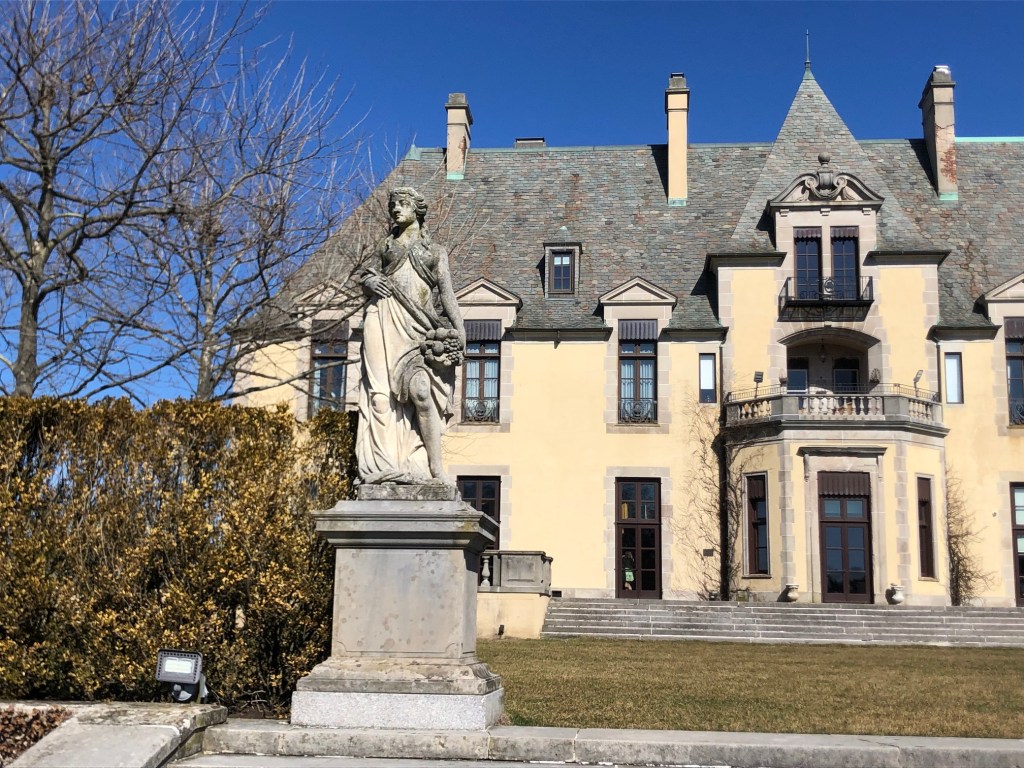
Oheka Castle, named for its owner, financier Otto Hermann Kahn, was completed in 1919. While other area mansions, like Coe Hall at Planting Fields Arboretum and Hempstead House at Sands Point were built in the Tudor Revival style, Kahn’s home was based on French Renaissance models.
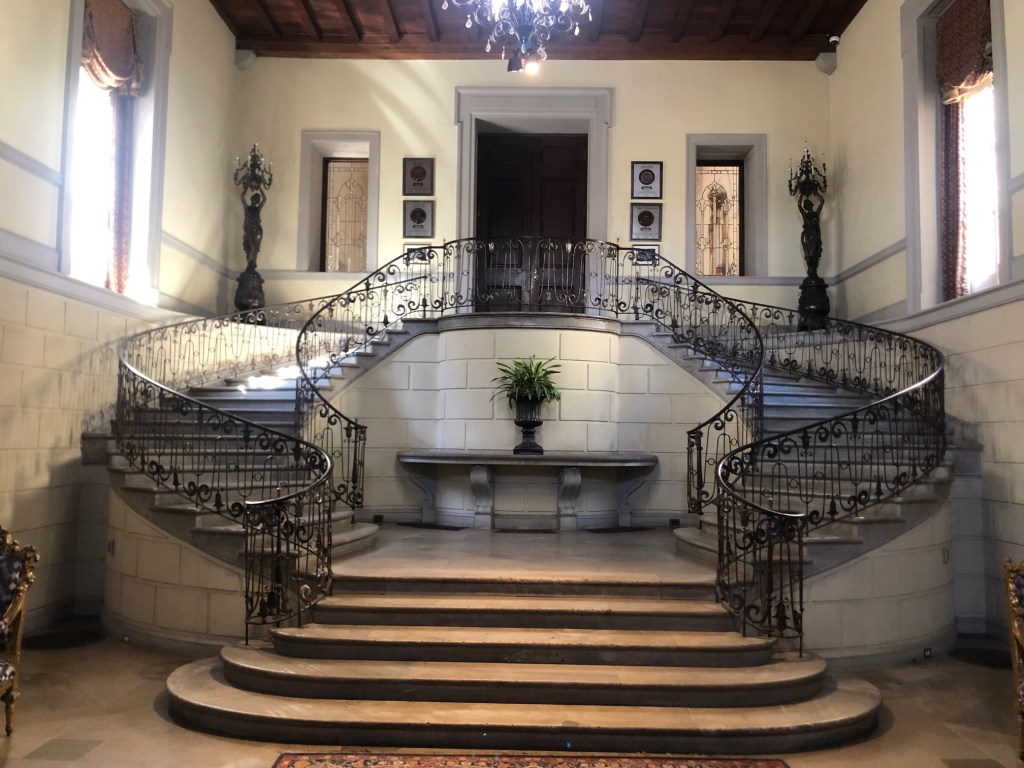
You’re greeted by this elegant grand staircase. The wrought iron staircase was created by Samuel Yellin, who produced ironwork for other mansions of the period.
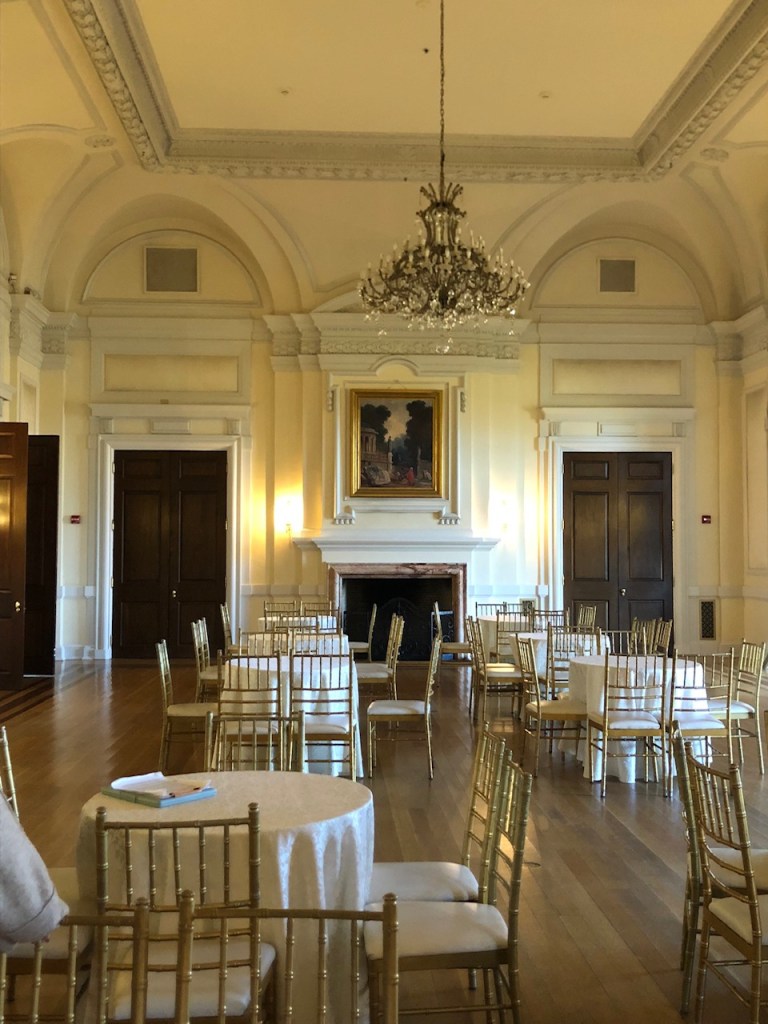
Kahn threw many parties here, entertaining celebrities like Charlie Chaplin, Douglas Fairbanks, and Enrico Caruso. While the decoration of this ballroom is not original, it is faithful to the era, and gives a sense of the luxury that he and his guests enjoyed.
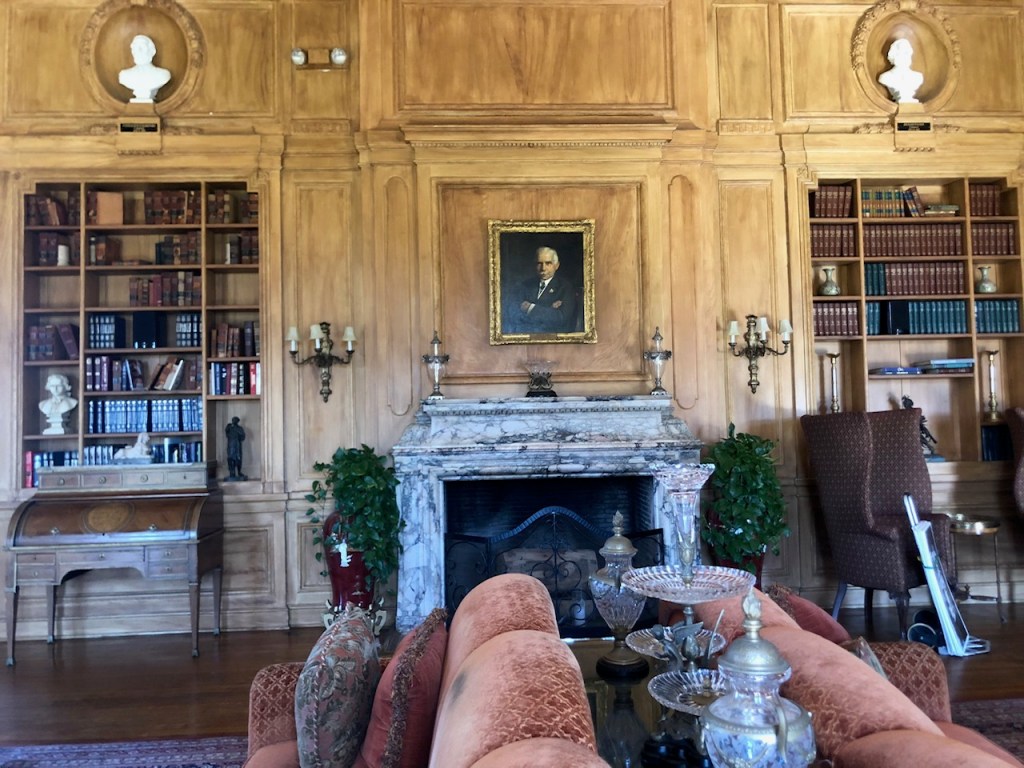
Here’s the stately library, with Kahn’s portrait hanging over the fireplace. (He is said to have been the inspiration for “Mr. Monopoly.”) The walls may look like wood, but they’re actually painted plaster! The castle was constructed to be fireproof.
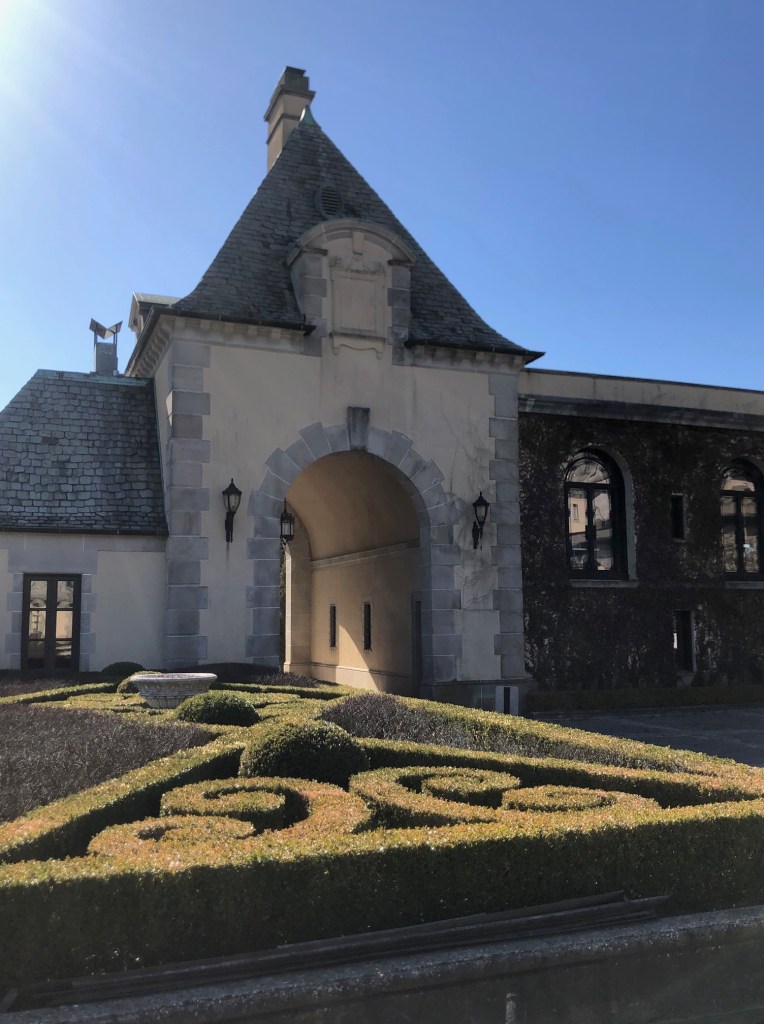
Oheka still retains a French style garden, with clipped hedges, statues, reflecting pools and statues, like the one seen above. When I visited, the fountains were still turned off for the winter, but it was still a great pleasure to walk around!
After Kahn’s death in 1934, the castle was put to different uses…including being a vacation venue for New York sanitation workers! Eventually, the building was abandoned and fell into a severely neglected state. Luckily, the developer Gary Melius bought the property in 1984 and restored it.
Today, the castle has been reborn as a luxury hotel and event venue. You can visit as I did, by buying a ticket for a guided tour…or you can make a reservation at the hotel’s restaurant. Either way, it’s a treat to experience this beautiful Jazz Age mansion!
Today I’ll be sharing some artwork by Jasper Groat, a 25 year old artist based in Snohomish WA. Jasper creates elegant pen and ink drawings of mystical, otherworldly beings. Recently, I had a chance to ask him a few questions about his art and his creative process.
IP: Firstly, where are you based, and what’s your art background? Have you studied at art school?
Jasper: I am born in the Pacific Northwest, I started to drawing at around age 5 and more seriously at age 11. So far I’ve only taken art classes at high school and community college.
Jasper Groat
IP: What would you say have been the strongest influences on your artwork, either artwise or in other areas?
Jasper: My strongest influence would be a Fairy artist named Brian Froud who sketches and paints what he sees through his heart and through nature. To him, he’s not just drawing “fantasy” but a mirror image of reality!
He was actually a concept artist for two movies called Labyrinth and The Dark Crystal! And throughout his career he has been a illustrator for many books!
Dream Chaser, Jasper Groat
IP: Could you describe the process of how you go from an initial idea to a finished artwork?
Jasper: I immediately go straight from pen to paper just so the idea that’s in my head is already put into light and fruition! I rarely use pencils when drawing because I want my art to appear clean and perfect!
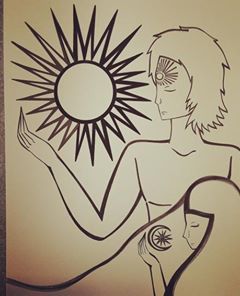
Children of Light, Jasper Groat
IP: Looking at your art, Jasper, I get a strong mystical, symbolic quality from it. What do you want viewers to get from your work?
Jasper: I want them to feel enlightened in some way…to me I see art as equivalent to magic! Even for writing, to cast a spell is simply to spell!
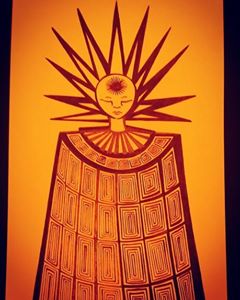
Sun Shaman, Jasper Groat
IP: Finally, what artistic goals or plans do you have for yourself in the future?
Jasper: I am definitely planning on doing more religious themes and even creating a series of Tarot cards in the distant future!
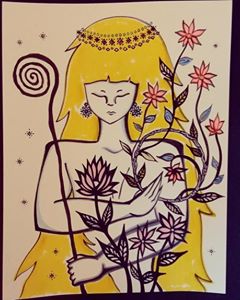
John the Baptist, Jasper Groat
IP: That sounds amazing! I want to thank you for taking the time to talk about your art with me.
I have to confess that the coronavirus quarantine, and its succession of unstructured days being confined to the house, has made it challenging to stay motivated and focused as an artist. However, one of the things I’ve found most helpful is the uplifting and comforting power of nature. I’m fortunate in that there are a number of parks and public gardens nearby. Walking around outside, even for an hour or so, really helps my state of mind. What’s more, plants, animals, and water offer many opportunities for inspiration.
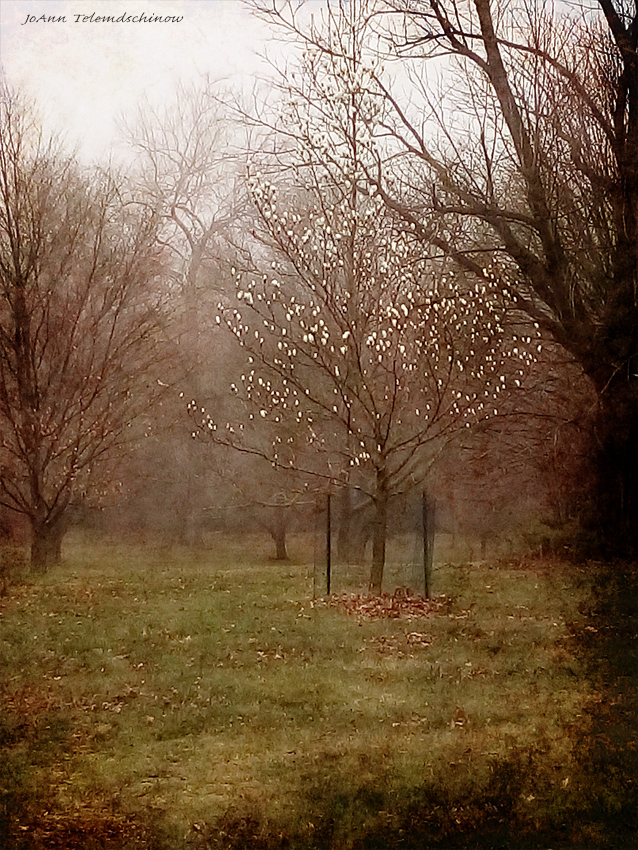
Tree with White Flowers
I took this photograph at Rutgers Gardens in New Brunswick. The white flowers really stood out on the misty, overcast day that I was there. I added a distressed texture and enhanced the lighting to play up this contrast.
Tree with White Flowers, (c) JoAnn Telemdschinow, 2020
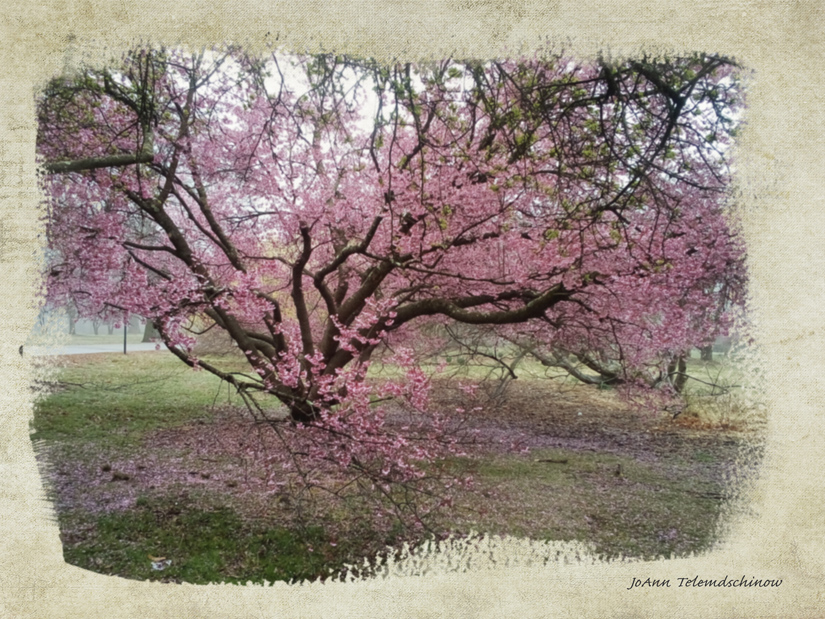
Spreading Cherry Tree
I was lucky enough to be at Rutgers Gardens when the cherry trees were blooming. This tree, with its masses of colored flowers, seemed magical in the dim light. I tried to capture its dreamlike beauty.
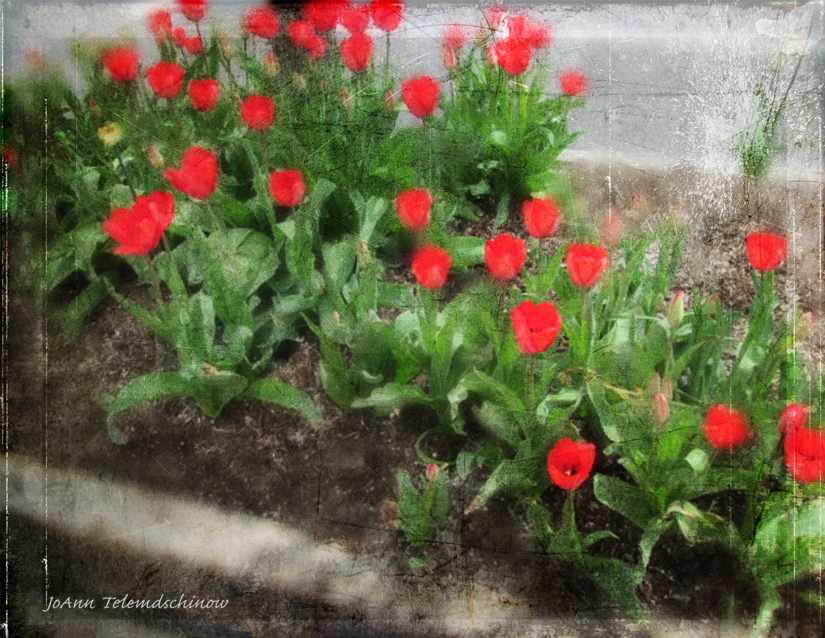
The day I took this photo, I had wanted to go to Rutgers Gardens again, but learned that it was closed. I spotted these flowers on one of the islands of the Target parking lot! I loved their vibrant red color. Here I overlaid a worn texture and selectively blurred the image, giving it a soft, dreamlike quality.
Tulips, (c) JoAnn Telemdschinow, 2020
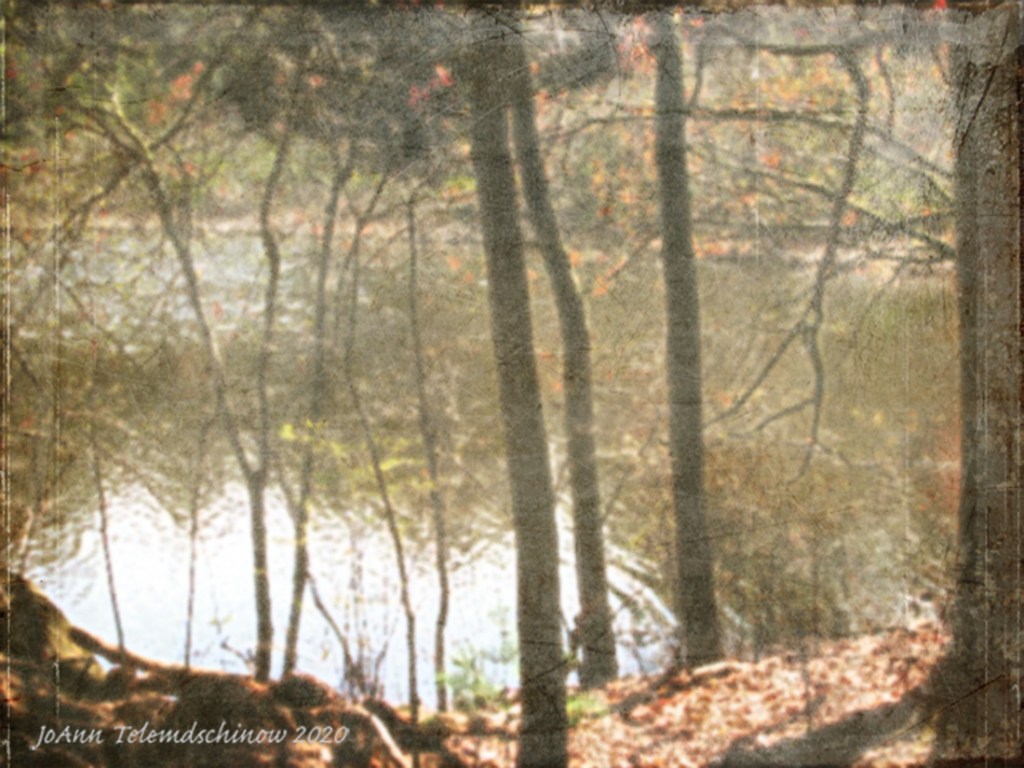
Pond, Bicentennial Park
This is a quiet park tucked in a residential area of East Brunswick. The morning I visited it, there were only a handful of people there, and all I could hear was the rustling of the leaves and the birds chirping in the trees. I came across this vista of a small pond. I liked the view of the pond through the trees, and the reflection of light on the water. I took the photograph, but later used texture and lighting effects to suggest a peaceful, Impressionist painting.
Pond, Centennial Park, (c) JoAnn Telemdschinow, 2020
I hope you’ve been coping with the challenges of life in quarantine. What helps you cope? Please feel free to share your thoughts with me!
This post was originally featured as a guest blog I wrote for Lauren’s Creative Corner, an art blog by Lauren Curtis.
My name is JoAnn Telemdschinow and I’m the founder of Imagined Past. I’ve always loved and been fascinated by art, but I haven’t always been sure how I should express it. While I have a background in art history, I have not studied painting or drawing. On an impulse, I started playing with collage, and found I liked it very much. In 2014, I started learning Photoshop Elements. Since then, through magazine articles and online tutorials, I’ve been developing my skills and exploring how to create different effects.
What inspires my collages? Perhaps the most obvious influence is the art and architecture of the past, medieval times, eighteenth and nineteenth century painting, as well as Chinese and Japanese art. I can happily spend hours in a museum! I also love to travel. I recently went to Paris and took photographs of beautiful old streets and buildings, some of which I’ve turned into collages. I’m interested in languages and scripts, both ancient and modern.
Me in Paris
A collage may originate from an image that captures my attention, or from an idea that I want to express. I often utilize vintage art to build my pieces, although I also use my own photographs. I am also fond of incorporating old texts, such as handwriting, book pages, or advertising, into the composition. I try to use texts that relate to the subject of the piece, either through content or cultural origin. Textures play an important role in my collages as well…old paper, distressed surfaces.
I Loved You, (c) JoAnn Telemdschinow
What am I trying to convey to the viewer? Well, I myself am deeply moved by beauty so I try to make my compositions visually beautiful. Beyond that, I attempt to express a feeling or atmosphere. My pictures (like myself) tend to be reflective and nostalgic. I also sometimes imply a bit of a narrative, as in I Loved You with its forlorn woman and titular inscription.
I’ve displayed my work in a number of area venues, such as The Gallery at the South Brunswick Municipal building and Inspire Art Gallery & Studio in Dunellen. Recently, I’ve also been honored to receive awards from the New Jersey State Bar Foundation (Chair’s Merit Award, Annual Juried Art Show) and the New Brunswick Free Public Library (Third Place-Adult, 2019 Visual Arts Contest and Exhibition).
French Roses, (c) JoAnn Telemdschinow
What do I have planned for the future? I would like to explore photography further and use more of my own photos in my collages. I’m working to promote my artwork through social media and my website. And I’ll be exhibiting in more shows in the upcoming year. I enjoy meeting and talking to people at shows…perhaps I’ll get to meet you at one soon!







 JoAnn's Imagined Past